
Marietta Wood Flooring brings more than twenty years of wood-flooring work to Atlantic Station, where nearly all of our jobs happen inside owner-occupied condominium units rather than detached houses. That changes almost everything about how a floor project is scheduled, staged and finished. We plan around elevators, loading areas, shared hallways and the people living a few inches of building away from you.
Most owners who call us are ready to move past the floors their unit came with. Some want solid hardwood or a wide plank engineered floor in place of carpet or vinyl plank, while others have a wood floor that has picked up traffic lanes, pet urine stains or sun fade near a tall window and needs a proper refinish. We handle both, and we quote each part of the job separately so you can see where the money goes.
Before any of that, we sit down with your own condominium declaration and the association’s written rules. We do not guess at what they say, and we do not tell you what they require until we have read them with you.
Condominium Floors on the Old Atlantic Steel Site
Atlantic Station occupies the 138-acre brownfield where the Atlantic Steel mill operated from 1901. The site needed extensive cleanup before redevelopment, which began in the late 1990s, and the first residents moved in during October 2003. The neighborhood officially opened in 2005, and it now holds condominiums, townhomes, lofts and apartment buildings on the northwestern edge of Midtown, inside the City of Atlanta and Fulton County.
A Neighborhood Built in One Decade
Census figures for ZIP code 30363, which we use as a labeled proxy because the ZIP and the neighborhood are not verified to share a boundary, show how compressed that building period was. In that proxy area, 73.2 percent of housing units were built between 2000 and 2009. Very little here predates the redevelopment, and very little has been added since 2020.
For floor work, a single build decade means most units reached the same age at the same time. Floors that went in during the mid-2000s are now around twenty years old, and many owners are reaching the replacement decision in the same few years as their neighbors.
Owners Living in Large Buildings
The same proxy shows 55.7 percent of households owning their homes, a solid majority for a dense urban neighborhood. Of those owner households, 90.2 percent live in buildings of fifty or more units. The typical client we meet here owns a unit in a mid-rise or tower building and shares walls, corridors and a roof with dozens of other households.
That ownership pattern is the reason this page reads differently from our pages about detached homes. The work is still sanding, fitting and finishing, but the logistics, the neighbors and the association all shape the project from the first call.
Looking for wood-flooring closer to Chamblee? See Wood-Flooring in Chamblee.
Replacing a Unit’s Original Floors After Twenty Years
A floor that has lived through two decades of daily use tells us a lot once we see it. Some units were refinished along the way, some were covered with rugs and barely touched, and some were already changed once by a previous owner. We do not assume what went in when the building was new; we look, measure and test before we recommend anything.
Refinish, Recoat or Replace
If your unit has a wood floor with enough wear layer or solid wood left above the tongue, a full sanding and a new finish can bring it back without tearing anything out. When the finish is only dull and scuffed, a screen and recoat is quicker and quieter. For engineered boards, we check the engineered wear layer at a vent or a transition before any drum sander or orbital sander touches it, because a thin wear layer can only take a light pass.
When the floor is past saving, replacement is the honest answer. Board gapping across a whole room, repeated water stains near a kitchen or laundry, or boards that have come loose at the ends are common reasons we recommend new material over another refinish.
Replacing Carpet, Laminate and Vinyl Plank
Many condo owners ask us to pull carpet, carpet pad and tack strip, or to lift an older laminate or luxury vinyl plank floor, and put down wood. We confirm what the declaration allows before the old floor comes up, since in an attached building the choice of product and installation method can matter to more people than you. From there we lay out the rooms, plan reducer and quarter round details at every transition, and set the expansion gap the product calls for.
Common choices here include white oak and red oak in plank widths from standard to wide, plus hickory and maple for owners who want a harder surface under pets or heavy traffic. We bring stain samples to the unit so you judge color in your own light, which matters in a corner unit with a wall of glass.
Moisture Before Any Sanding
We read the floor with a moisture meter before we sand it, and we do it every time. Atlanta summers are humid, and a floor that has crowned or cupped from moisture can look flat once it is ground down, then settle the wrong way after it dries. Checking first keeps us from sanding a floor that is still wet.
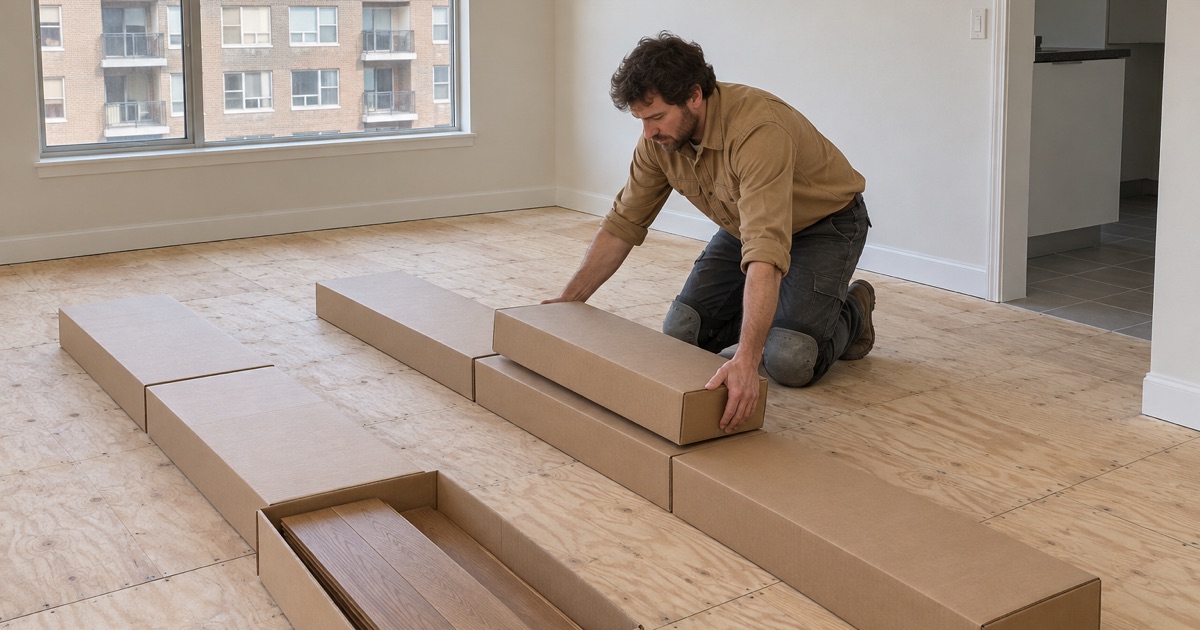
New boards also get time to acclimate inside the unit before installation. In a building with central air, that step is usually straightforward, but we still measure rather than assume.
Working in a Building With Neighbors Above and Below
A condo floor project in a fifty-unit building is a shared event, even when the work stays inside your walls. Noise, dust, deliveries and debris all pass through common areas, and a careless crew can make an owner’s relationship with the building harder for years. We work in a way that keeps the job contained.
Noise, Hours and Deliveries
Sanding and cutting are the loudest steps, so we group them into as few days as the job allows. We ask building management about permitted work hours, elevator reservations and where a crew may load and unload, and we schedule around those answers. Material deliveries arrive when the elevator is booked, not when a truck happens to show up.
We also keep a simple plan for the week that you can share with management or the neighbors you know. When people know which days will be loud, a project goes more smoothly for everyone on the floor.
Dust and the Shared Hallway
We use dustless sanding with a vacuum system connected to the sander, and we protect hallway carpet and elevator walls on the route in and out. Old flooring leaves the building bagged or wrapped, never dragged through a lobby. At the end of each day the corridor outside your door should look the way it did that morning.
Finish choice matters in a closed building, too. We select clear finishes by their federal VOC category under 40 CFR 59 Subpart D rather than by the floor-coating limit written for opaque coatings, and many condo owners pick a waterborne polyurethane because it dries fast and carries less odor into shared air than an oil-modified polyurethane.
When Water Comes From Upstairs
In a stacked building, a leak from a unit above is a risk a detached house never faces. When that happens, we trace where the water traveled, dry and measure the area room by room, and photograph the readings before a single board comes up. That record helps you, your insurer and your association sort out what happened and who handles which repair.
Damaged boards can often be cut out and laced in with matching material so the repair blends into the surrounding run. Where the damage is wide, we explain whether a partial replacement will read cleanly or whether a room needs a full new floor.
Planning Floor Work With Your Condominium Association
Condominium buildings in Atlantic Station are run by their own associations, which govern common areas and owner projects building by building. We do not know your building’s rules until we read them, and we will not guess at an answer about approvals or products. What we can do is help you gather the right documents and ask the right questions early.
Reading Your Declaration First
Your declaration, bylaws and any written rules adopted under the Georgia Condominium Act are where flooring questions get answered for your building. We read the sections on alterations, flooring and contractor access with you, note anything that calls for a submission to management, and build the schedule around it. If a document is unclear, we suggest you ask the association in writing before work begins.
That step costs a few days at most, and it protects you from starting a project that has to stop halfway. It also gives management a clear, dated description of the work, the crew and the product.
Mid-Rise and Tower Units
Atlantic Station is split into the District, the Commons and the Village, and its housing ranges from townhomes to mid-rise blocks to towers. Art Foundry, for example, was built in 2005 as eight mid-rise buildings with roughly 347 condominium homes, and its street-level unit entries mean some owners carry material straight in from the sidewalk. Tower units, such as those in the 26-story TWELVE Hotel and Residences completed in December 2005, depend entirely on elevator scheduling and loading access.
We plan each job for the building it sits in. A ground-floor mid-rise unit and a high tower unit may need the same floor, but the staging, timing and delivery plan are rarely the same.
Build Year and Lead-Safe Rules
We check the build year of every home before sanding, because the federal EPA RRP Rule applies to homes built before 1978. Units built from 2003 onward fall well after that date, but the proxy area includes a small number of older homes, so we confirm the year rather than assume it. For most Atlantic Station condos, the answer is simple and the work proceeds on the normal schedule.
Stairs, Lofts and Multi-Level Units
For townhome and loft units with an interior staircase, we price stairs tread by tread instead of by the square foot. Stair treads, stair risers and stair nosing each take separate fitting and finishing time, so a per-step quote is the only fair way to show that cost. When a staircase meets new wood at the landing, we match species, stain and sheen level so the two read as one floor.
If you own a unit in Atlantic Station and are weighing a refinish or a full replacement, we will visit, read the floor, go through your building’s documents with you and give you an itemized estimate. From there, the decision and the schedule are yours.
- 20+ Years on Wood Floors
- Free Written Estimates
- Moisture Checked Before Sanding










