
Marietta Wood Flooring has spent more than 20 years on wood-flooring in College Park, and most of that work comes down to one question: what is this floor, and what has already been done to it? We sand, refinish, repair and install hardwood, and we start every job by reading the boards in front of us rather than assuming.
That matters in a city where a single block can hold a house from the 1890s next to one from the 1970s. We check the build year before a sander is plugged in, look for old wax or shellac under the current shine, and put a moisture meter on any board that has cupped. What we find decides the plan, and you see it before any work begins.
Homeowners, landlords, buyers and sellers all call us for different reasons. Some want a tired floor brought back, some need termite damage repaired before a closing, and some want carpet pulled and hardwood laid in its place. The sections below walk through how that work changes across the housing you actually find here.
Floors in College Park’s 1882-1946 Historic Houses
The College Park Historic District was entered in the National Register of Historic Places on November 15, 1996, with 842 contributing buildings. Its nomination dates the houses from 1882 to 1946 and describes them as wood frame, brick, stucco and stone. The district covers roughly a quarter of the city’s area, running along either side of Main Street.
For floor work, that date range is the useful part. Houses from those years were built long before modern prefinished flooring, long before waterborne polyurethane, and long before 1978, the cutoff the EPA RRP Rule uses for lead-safe work practices. We treat each one as a house with a long finish history until the boards tell us otherwise.
Three Waves of Building
The nomination describes development in three thrusts: the 1890s, 1905 to the late 1920s, and the 1930s to the mid-1940s. The oldest and some of the largest houses cluster near the railroad and Main Street. A house from the first wave and one from the third can sit a few blocks apart and carry very different floors.
We do not guess at species or age from the street. We pull a register cover, look at a threshold or check a closet corner where the board edge shows, then decide on a grit sequence. Tongue and groove boards that have been sanded several times need a lighter hand than a floor that has only been waxed.
Small Lots, Compact Rooms
The nomination notes that most district lots are small, 75 by 150 feet, and rectangular. On those footprints many houses are compact, with rooms that open into each other and hallways that tie them together. That shapes how we stage a refinish.
We plan the work so one side of the house stays usable while the other is sanded and coated, where the layout allows. Dustless sanding helps in houses where the family or a tenant is still living there. We also plan board transitions so a finished room meets an unfinished hallway cleanly at a reducer or threshold rather than at a ragged line.
Looking for wood-flooring closer to Lilburn? See Wood-Flooring in Lilburn.
Queen Anne, Folk Victorian and Craftsman Homes
The district’s architecture runs through Queen Anne, Folk Victorian, Craftsman and several revival styles, including Colonial Revival, Tudor Revival and Spanish Colonial Revival. The nomination describes everything from small one-story cottages to large Victorian mansions. Each style tends to bring its own floor problems.
Victorian Rooms and Old Heating
Queen Anne and Folk Victorian houses often went through several heating systems over a century. When a floor furnace, a wall or a register comes out, it leaves a hole or a patched rectangle in the middle of the room. We weave new boards into the old run so the repair reads as part of the floor rather than a square of mismatched wood.
Lacing in works board by board, staggering the ends the way the original installer would have. We match width, thickness and grain as closely as the stock allows, then sand the whole field together so the patch takes the same finish. A good repair disappears once the floor is coated.
Craftsman Bungalows and Old Finishes
Craftsman bungalows are common in the district, and many of their floors have been waxed or shellacked at some point. Paste wax and shellac look fine until someone rolls a modern polyurethane over them, and then the new coat peels. We test for both before anything else goes down.
When we find wax or shellac, we strip it fully before choosing a finish. From there you pick between waterborne polyurethane, oil-modified polyurethane or hardwax oil, and a sheen level. We lay out stain samples on the actual floor, because a color on a sample board rarely matches what a century-old board does with it.
Lead-Safe Work in Pre-1978 Houses
The district’s houses all date from 1946 or earlier, so work that disturbs paint in them falls under federal lead-safe rules. We confirm the build year first and set up the job to follow the EPA RRP Rule. That covers the painted baseboards, quarter round and stair risers we often have to disturb along the way.
In practice that means containment around the work area, careful handling of painted trim we pull and reset, and a thorough cleanup before you walk back in. It adds some time to the setup. It is also the part of the job most worth doing properly in a house this old.
The East Side, the Airport and the Houses That Remain
According to the nomination, the older historic residential section lies east of the commercial district. The City of Atlanta acquired much of that original property on the south and east for airport expansion. Many large houses and bungalows still stand, and the nomination notes that a large number of the district’s properties are rental.
That leaves a housing stock where historic floors are often owned by landlords rather than the people walking on them. The work has to fit a lease calendar as much as a restoration standard. We plan around both.
The town itself was founded as Atlantic City in 1890, incorporated as Manchester in 1891 and renamed College Park in 1896. The houses that survived the acquisitions carry decades of that history in their boards. Keeping them in service, rather than covering them with laminate between tenants, is work we are glad to do.
Refinishing Rental Houses in the Historic District
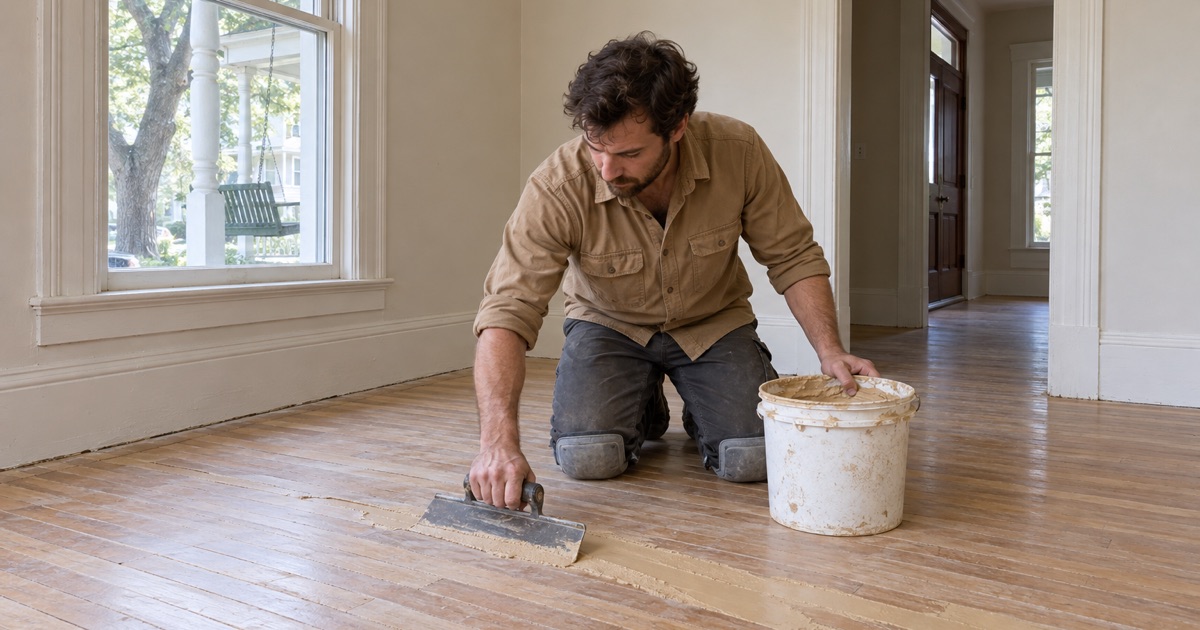
For landlords, a turnover is the natural moment for floor work. We can screen and recoat a floor that is only worn through the traffic lanes, or run a full sand when pet urine stains, water stains or sun fade have gone into the wood. The choice depends on how much finish is left and whether stains sit on top or have soaked into the board.
We also write itemized floor-damage estimates a landlord can set against a move-out inspection. Each room gets its own line, with the damage described and photographed. That record makes the conversation about a deposit a lot shorter.
Termite Damage Before a Closing
Old wood frame houses draw subterranean termites and powderpost beetles, and a sale is often when the damage surfaces. An Official Georgia Wood Infestation Inspection Report that notes damaged boards can put a closing date at risk. We help both buyers and sellers get the flooring side handled on time.
Once the pest company has treated, we cut out the damaged boards and lace in matching ones. We never fill over frass or hollowed wood, because the soft spot stays soft under the filler. The repaired area is then sanded and finished with the rest of the room.
College Park’s 1960s and 1970s Housing
Census estimates show that 70.6 percent of College Park’s housing units predate 1980, and 906 were built before 1940. The 1970s is the largest single build decade, at 26.7 percent of all units. So while the historic district shapes the city’s character, much of the flooring we see is mid-century and later.
These houses and apartment buildings bring a different set of jobs. Strip oak from that era is common, and so are finishes applied over it by several owners. Many have been covered, patched or refinished more than once.
Refinishing Builder Oak
Red oak and white oak strip floors from the 1960s and 1970s often sit under carpet or a yellowed finish that turned orange oak over time. Before sanding, we check how much wood is left above the tongue. If there is enough, a full refinish is almost always cheaper and better than tearing the floor out.
Where the wear layer is thin, we sand conservatively and may recommend a screen and recoat instead. Board gapping, hollow spots and small areas of crowning or buckling get repaired before finish goes on. The goal is a floor that lasts another round, not one sanded to the nail.
Moisture Before the Sander
Georgia summers are humid, and a cupped floor in July is often just a wet floor. We read it with a moisture meter before sanding, because grinding the high edges flat while the boards are swollen leaves them crowned once they dry. If water damage is the cause, we trace it, dry it and document it room by room first.
For levels set into a hillside or below grade, solid hardwood is the wrong choice. We install engineered wood with a proper vapor retarder there instead. It gives you the look of wood without the movement solid boards would show.
Replacing Carpet, Laminate and Vinyl
Many units from these decades carry carpet, laminate or luxury vinyl plank laid over whatever came first. We pull the carpet pad and tack strip, deal with any black mastic, and install hardwood in its place. Stairs are quoted tread by tread, with new stair treads, risers and nosing as needed.
For townhomes and condos, we read your own association declaration before starting, since flooring rules vary from one community to the next. That check takes a few minutes and prevents a floor from being installed and then ordered out.
- 20+ Years on Wood Floors
- Free Written Estimates
- Moisture Checked Before Sanding










