
Marietta Wood Flooring has spent more than 20 years on wood-flooring in Fairburn and the south side of metro Atlanta, and most of the floors we see here are younger than the people who own them. That changes the job. A house finished in 2006 usually needs a sand and refinish, a board repair or a carpet swap, not the deep restoration an older house calls for.
We sand, refinish, repair and install solid hardwood and engineered floors, and we price stairs tread by tread instead of folding them into a square-foot number. Before any drum sander touches a floor, we take moisture readings, look at how much wood sits above the tongue and check the build year. Those three readings decide whether a floor gets a full sand, a screen and recoat, or a repair first.
If you are selling, buying, renting out or simply tired of looking at worn traffic lanes, the sections below walk through how that work usually plays out in a Fairburn house.
Floors in a Former County Seat That Mostly Went Up After 2000
Fairburn carries an older identity than its housing suggests. It served as the seat of Campbell County from 1871 until 1932, when the county merged into Fulton and the city gave up that status. Its railroad-era downtown, the Fairburn Commercial Historic District, was entered in the National Register on October 20, 1988, and the nomination describes residential development to the east and west of it. The 1871 Campbell County Courthouse from that era is itself listed in the National Register.
Most of the homes around that core are far newer. Census estimates count 6,479 housing units in the city, and 68.2 percent of them were built in 2000 or later. The single largest share, 41.4 percent, went up between 2000 and 2009, so a typical floor we are asked about here is somewhere between seventeen and twenty-six years old.
What a Floor of That Age Usually Needs
A site-finished floor laid in the mid-2000s has often been through two or three sets of owners, a couple of dogs and years of chair traffic. The finish is worn through in the kitchen and hallway, gray traffic lanes run from the back door, and pet urine stains have darkened a few boards near the stairs. That is normal wear, and most of it comes out with a careful grit sequence.
Prefinished floors from the same years behave differently. Their factory finish is hard to sand evenly because of the beveled edges, so we test a small area and talk through whether a full sand makes sense or whether the boards themselves should be replaced.
Reading Moisture Before Anything Else
Humid summers leave some floors cupped by August. We read the boards with a moisture meter first, because sanding a cupped floor flat while it is still wet leaves it crowned once it dries out. If the readings are high, we find the source, let the floor settle and come back to sand when the numbers say it is ready.
The National Weather Service groups the city into its South Fulton forecast zone, GAZ044, and the muggy stretch of the year shows up inside as much as out. Running the air conditioning or a dehumidifier through summer keeps indoor humidity steadier, which keeps boards from swelling at the edges. New flooring also gets time to acclimate in the house before we install it, so it starts out close to the conditions it will live in.
Looking for wood-flooring closer to Cumming? See Wood-Flooring Services in Cumming.
Refinishing and Upgrading Fairburn’s 2000s and 2010s Houses
The 2000s were the biggest build decade, but the 2010s added 1,385 more units and another 349 have gone up since 2020. The city grew from 12,950 people in 2010 to 16,483 in 2020. Across all of those houses, the same few requests come up again and again.
Bringing Builder Oak Back
Plenty of these homes left the builder with red oak or white oak in the foyer, dining room and main hallway, finished in a stain that has since turned orange. We refinish that wood rather than rip it out, after checking how much wood remains above the tongue so we know how many sandings it has left. Stain samples go down on the actual floor, and you choose from those, not from a printed chart.
For the finish, we choose clear coats by their federal VOC category under 40 CFR 59 Subpart D, not by the number written for opaque floor coatings. Waterborne polyurethane, oil-modified polyurethane and hardwax oil each look and wear differently, and we lay out the tradeoffs in sheen level, cure time and upkeep before you decide.
Swapping Carpet and Vinyl for Hardwood
A lot of 2000s houses have carpet upstairs and on the stairs, and some owners added laminate or luxury vinyl plank later. We pull the carpet pad and tack strip, check the subfloor for flat and for squeaks, and install solid hardwood or engineered boards to match or blend with what is already downstairs. Stairs get new treads, risers and stair nosing so the run looks like one piece.
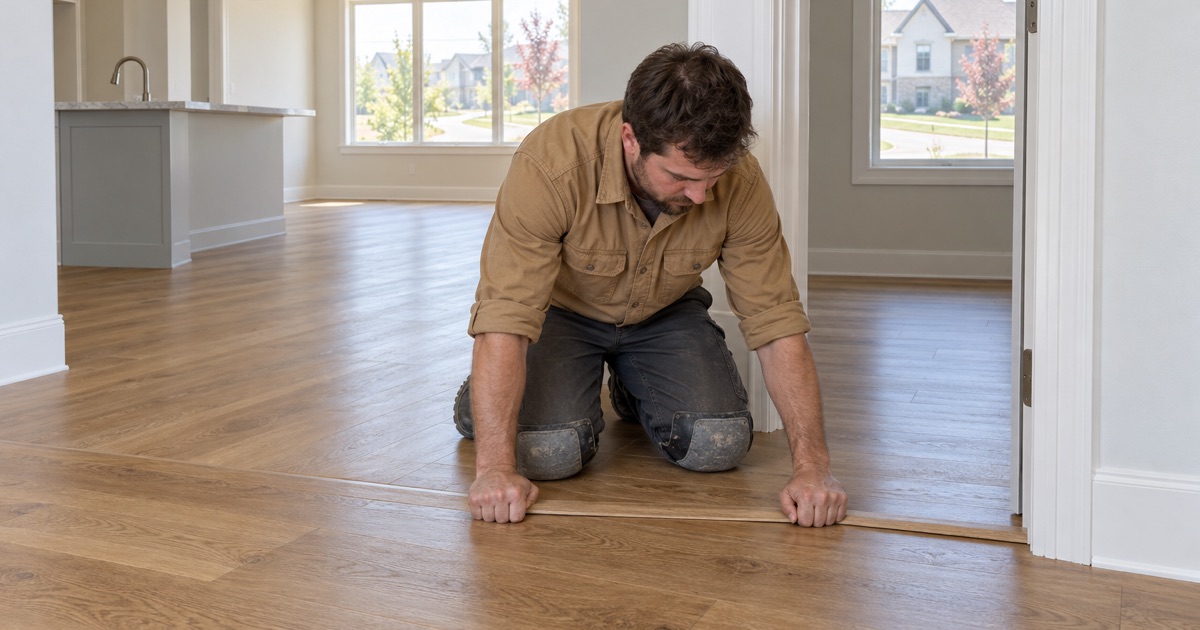
Transitions matter more than people expect. A reducer at the tile, quarter round along the base and the right expansion gap at the walls are the difference between a floor that looks built in and one that looks laid on top.
Houses Built Since 2010
Newer houses usually need less correction and more protection. A screen and recoat every few years keeps the existing finish from wearing through, and it costs far less than a full sand. When a newer engineered floor has a thin wear layer, we tell you plainly how many refinishes it can take before we start.
Some owners of newer homes want a change rather than a repair. Wide plank white oak, hickory or maple can replace a narrow builder strip, and a herringbone or chevron pattern in an entry gives a plain foyer some character. We talk through Janka hardness, pets and sun fade near big windows before you commit to a species or a pattern.
Older Homes Near the Historic Downtown
Older houses are the minority here. Only 66 units in the city predate 1940, and about 20 percent were built before 1980. When we do work in one, it is often in the older residential streets closer to downtown, and it calls for a different set of checks.
Build Year and Lead-Safe Work
Federal lead-safe rules under the EPA RRP Rule reach homes built before 1978, so we check the build year before we sand. An older finish in one of those houses gets tested and handled under those rules, with containment and cleanup planned before the first pass. In a 2004 house the question never comes up, which is part of why we ask it on every job.
Old Finishes and Patched Floors
Floors in older homes sometimes carry paste wax or shellac under a later coat. We identify it and strip it before a modern finish goes down, because polyurethane will not bond to wax. We also patch the gaps where a wall came out, a floor furnace was removed or a register was moved, lacing new boards into the old run so the repair disappears.
Older floors also tend to show board gapping that opens in winter and closes in summer. We explain which gaps are seasonal and which point to loose boards or a subfloor problem, and we only fill or replace where the movement is not going to reopen the next season.
Termite and Beetle Damage
Subterranean termites, powderpost beetles and old house borers all leave their mark in Georgia wood. Frass, mud tubes and hollow spots under foot are the usual signs. Once your pest company has treated, we cut out the damaged boards and lace in matching ones rather than filling over them.
Insect damage is not limited to older houses, either. Subterranean termites can reach a floor of any age, which is why we probe hollow spots and look at the joist edges we can reach before quoting a repair. The replacement boards are sanded and finished with the surrounding floor so the patch blends in.
Floor Work Across Fairburn’s Owner-Occupied Houses
About 64 percent of occupied homes in Fairburn are owner-occupied, and 91.4 percent of owner households live in one-unit detached houses. That makes most of our work here whole-house jobs: several rooms, a staircase and a hallway, sometimes done in phases around a family still living in the home.
Phasing works best when we plan it up front. We usually finish bedrooms and upstairs halls first, then the main floor, so the kitchen stays usable as long as possible. Dustless sanding keeps the cleanup manageable, and we tell you how long each coat needs before furniture and rugs can go back.
Sales, Closings and Termite Letters
When an Official Georgia Wood Infestation Inspection Report turns up damaged boards ahead of a closing date, the floor repair often has to fit between the treatment and the walk-through. We work with sellers and buyers on that timeline and document what was replaced so the paperwork matches the floor.
Timing is usually the hard part. We can give you a written scope and price quickly, and we schedule the board replacement so the finish has time to cure before the final walk-through. If the buyer’s agent asks what was done, the photos and the list of replaced boards answer that question.
Water Damage and Rentals
A leaking dishwasher or a failed supply line can buckle a kitchen floor overnight. We trace the water, dry the area, and measure and photograph each room before any board comes up, so an insurance adjuster sees the same thing we saw. For the rental houses in the city, we write itemized damage estimates that a landlord can put against a move-out inspection.
Townhomes and Associations
Some Fairburn housing is attached, and a townhome community may have its own rules on flooring. We read those rules in your own declaration with you before work starts, so the job fits whatever your association has actually written down.
In a townhome, glue-down engineered or a floating floor over the right underlayment is often the practical choice upstairs. We go over the options with the association’s wording in hand, then install to the NWFA Installation Guidelines so the floor holds up for the next owner as well as for you.
- 20+ Years on Wood Floors
- Free Written Estimates
- Moisture Checked Before Sanding










