
Marietta Wood Flooring has handled wood-flooring in Forest Park for owners who keep houses as rentals, and over more than 20 years we have learned that the window between one lease and the next is when floor work actually gets done. A vacant house can be sanded, patched and recoated without moving a family’s furniture or asking a tenant to live around drying finish. The trick is fitting the work into the days you actually have.
Most of our calls from this side of the metro start with a move-out. The last tenant is gone, the carpet smells, the kitchen threshold has a water stain, and a hallway shows traffic lanes worn through the finish. We walk the rooms, write down what each one needs and hand back an itemized estimate you can hold against the move-out inspection, so the deposit conversation rests on paper rather than memory.
We also keep the scope honest. Not every scuffed floor needs a full sand, and not every stain means replacing boards. Our job at a turnover is to tell you what the floor needs to last through the next lease, what it will cost and how many days the rooms will be off limits.
Forest Park’s Rental Permit Follows the House
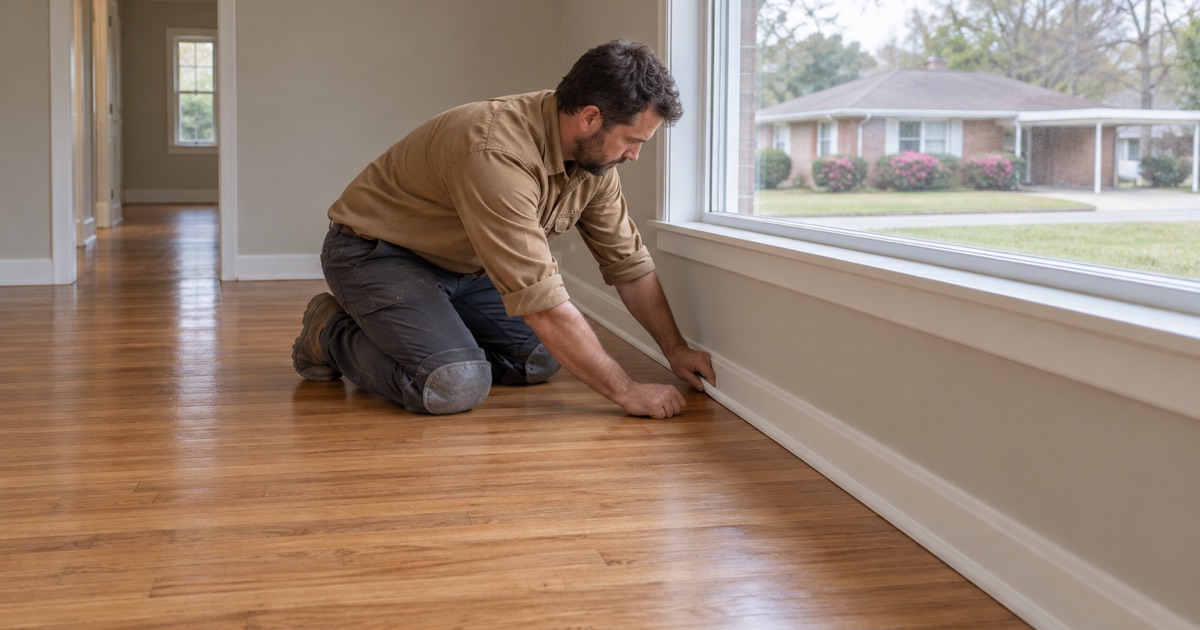
Floor timing for a landlord here is tied to a city rule, so it helps to know how that rule works before planning a turnover.
What Ordinance 47-2023 Covers
The City of Forest Park passed Ordinance 47-2023 on November 20, 2023, and its Rental Registration Program took effect on March 1, 2024. From that date, a residential rental where the owner does not live in the dwelling needs a rental permit. The ordinance names single-family houses and duplexes alongside apartment buildings and complexes, which means a single house you rent out falls under the program just as a larger property does.
The fee for a single-family or two-family house is $100. Every permit expires on March 1 and has to be renewed each year for as long as the house stays a rental. If the city has listed a property as a rental by mistake, a Non-Rental Affidavit is how an owner-occupant removes it from the program.
A New Tenant Means a New Permit
A permit runs out after one year or when the tenant changes, whichever comes first. That second trigger is the one that shapes floor work. Every turnover now carries a paperwork step with the city in addition to cleaning, painting and whatever the floors need.
We plan around that. When you tell us the move-out date and the date the next lease starts, we schedule the sanding and finish so the rooms are dry and furniture-ready before the new tenant arrives. A tight window usually points toward a screen and recoat rather than a full sand, and we say so up front instead of promising a refinish that cannot cure in time.
Looking for wood-flooring closer to Riverdale? See Riverdale Wood-Flooring.
What the City Walks Past and What It Leaves to You
Some landlords assume a city rental inspection will flag worn floors. In Forest Park it will not, and that changes who is responsible for noticing.
An Exterior Walk-Around Only
The permit comes with a yearly walk-around, exterior inspection. The city’s own wording is direct: “City inspectors will not be entering the dwelling unit or inspecting any interior areas as part of this permit.” Nobody from the city is going to look at the hardwood in the living room or the soft spot by the back door.
That means the permit tells you nothing about the condition of the floors. A house can hold a current permit while its kitchen boards are cupping from a slow leak under the sink. The only people who will see that are you, the tenant and whoever you bring in to look.
The Floor Record Is Yours to Keep
Because the city’s inspection stays outside, the landlord’s own documentation carries more weight. We photograph each room, note pet urine stains, water stains, sun fade near windows and gouges from furniture, and separate damage beyond ordinary wear from the gradual dulling any floor picks up over a lease.
Where water is involved, we trace it before a board comes up. A moisture meter reading tells us whether a floor is still wet, and grinding a humid-summer crown flat while the boards are damp only leaves them cupped once they dry out. We dry, measure and photograph room by room, which gives you a clear record if the question of cause comes up later.
A Vacant House in a Humid Summer
Empty houses create their own floor problems. When the air conditioning is shut off between tenants, summer humidity in Clayton County can push moisture into the boards, and a floor that was flat at move-out can show cupping or board gapping a few weeks later. We ask how the house was conditioned while it sat empty before we read anything into the shape of the floor.
If the boards are carrying extra moisture, we recommend running the air conditioning or a dehumidifier and letting the wood settle before sanding. Waiting a few days costs less than sanding a floor that will change shape again once the next household turns the thermostat down.
Turnover Work in 1950s and 1960s Houses
Forest Park’s housing stock skews old. In Census figures for the city, 55.9 percent of housing units were built in the 1950s and 1960s, and 78.0 percent went up before 1980. Among occupied detached houses, 40.3 percent are rented, so a large share of the single-family homes in town are someone’s rental.
Build Year Comes Before Sanding
A house from those decades falls well before 1978, which is where federal lead-safe rules under the EPA RRP Rule begin to apply. We check the build year before any sanding starts, because old finishes and painted trim near the floor can matter to how the work is set up and how dust is handled.
In a rental this is doubly important. The next household may include young children, and a turnover is the moment the house is empty enough to do the work carefully. We would rather confirm the build year and plan containment than find out halfway through a room.
Old Finishes Under the Carpet
Floors in houses this age have often been covered and uncovered more than once. When carpet comes up in a 1950s or 1960s house, we sometimes find paste wax or shellac from decades ago, and a modern polyurethane laid straight over either one will peel. We identify the old coating and strip it first so the new finish bonds.
Tack strip holes along the walls and staples from an old carpet pad are routine at this stage. We pull them, fill what needs filling and check for hollow spots before deciding whether the floor gets a full sand or only a screen and recoat.
Patches Where Something Came Out
Older houses tend to show their remodels in the floor. A wall moved to open a kitchen, a floor furnace removed, or a heat register relocated can each leave a gap or a patch of mismatched boards. We lace in new boards so they weave into the existing run rather than sitting as a square block that reads as a repair.
The same approach applies to termite or powderpost beetle damage. Once the pest company has treated, we cut out the damaged sections and lace in matching boards instead of filling over soft wood that will keep failing under a tenant’s traffic.
Floor Choices That Hold Up Between Leases
A rental floor has a different job than a floor in a house the owner will live in for twenty years. It needs to survive several tenants, clean up fast at each move-out and cost a predictable amount to bring back.
Finish and Sheen
For most rentals we lean toward a satin or matte sheen level, which hides scratches and dust better than gloss. Waterborne polyurethane dries faster and has less odor, which helps when the next lease starts soon, while an oil-modified polyurethane takes longer but gives a warmer tone on red oak. We choose clear finishes by their federal VOC category under 40 CFR 59 Subpart D rather than a number meant for opaque floor coatings.
A good finish also makes the next turnover cheaper. If the finish is kept intact, a screen and recoat between tenants can restore the surface without taking the floor back to bare wood each time, and that saves the remaining wood above the tongue for later.
Replacing Carpet and Vinyl Plank
Many landlords ask us to replace worn carpet, laminate or luxury vinyl plank with hardwood, stairs included. Hardwood lasts through more tenants than carpet and does not hold pet odors the same way. We price stairs tread by tread, since a staircase with nosing and risers is a different job from the same square footage of flat floor.
Where the existing floor is sound, refinishing is usually the better value than tearing out and replacing. We look at how much wood is left above the tongue before recommending a sand, because a floor that has already been sanded several times may only have one more refinish in it.
Species and Hardness for Rentals
When a room does need new wood, we talk through Janka hardness before color. White oak and hickory resist dents from furniture legs and pet claws better than softer species, and a plain red oak in a standard width is easy to match when a single board has to be replaced after a future lease. Wide plank and patterned layouts such as herringbone look good but cost more to repair piece by piece.
For a house that will keep turning over, we usually suggest a species and stain that can be touched up without a full-room refinish. A mid-tone stain hides wear and dust better than very dark or very light colors, and stain samples laid on the actual floor settle the choice faster than a showroom board.
Getting Ready for the Next Tenant
A realistic turnover plan balances what the house needs against how many days it can sit empty. We will tell you which rooms need attention now and which can wait for the next vacancy, and we write the estimate so each line is tied to a room and a reason.
That way the floor work, the permit renewal and the new lease line up on one calendar. When the house changes hands to the next tenant, the floors are dry, documented and ready for another year of use.
- 20+ Years on Wood Floors
- Free Written Estimates
- Moisture Checked Before Sanding










