
Marietta Wood Flooring handles hardwood floor repair in Marietta, GA, serving surrounding cities including Fair Oaks, Holly Springs, Smyrna, Kennesaw and Vinings. For more than 20 years we have cut out damaged boards, laced in matching wood, stopped squeaks and rebuilt floors where walls, registers and floor furnaces used to be.
Most damaged hardwood does not need to be torn out. A few stained boards, a gouged section near the kitchen or a gap where a wall came out can be repaired so the floor reads as one surface again. The skill is in the matching and the weaving: new boards that follow the old pattern, not a square patch that stands out forever.
We start every repair by finding why the damage happened. A board that failed from a slow leak, a pest or a loose subfloor will fail again next to the new one unless the cause is fixed first, so the estimate names the cause as well as the repair.
Board Replacement and Lacing In
Cutting Out Damaged Boards
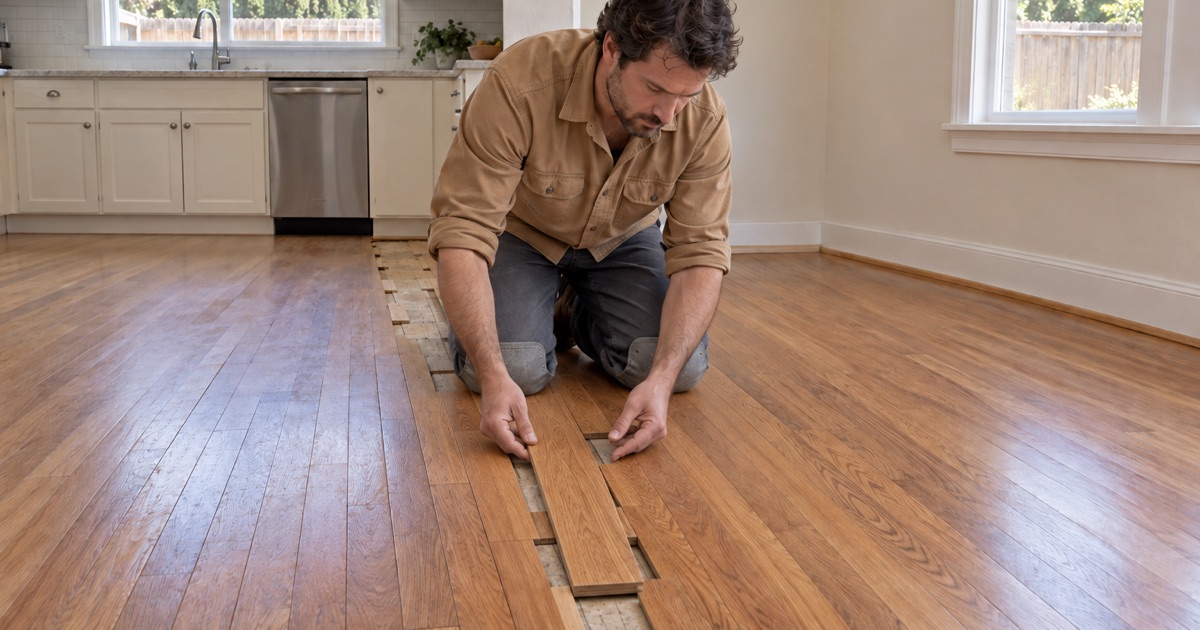
Board replacement starts with cutting the damaged board lengthwise, prying out the pieces and pulling the old flooring cleats or nails without disturbing the neighbors. The new board is fitted with its bottom groove lip trimmed, so it drops into place and is face-nailed or glued. Done properly, the replaced board is as solid as the ones around it.
We replace to sound wood, not just to the edge of the visible stain. Water and pet damage often travel further along a board than the surface shows, and stopping short leaves a dark line at the end of the repair.
Lacing In New Boards
Lacing in means removing boards in a staggered pattern and weaving new boards into the existing rows, so the joints fall at different points rather than lining up in a square. It takes longer than setting a rectangular patch, but it is the only method that makes a repair disappear once the floor is refinished.
On larger repairs we lace across several rows at once, pulling back into the old floor far enough that no two neighboring joints line up. The result is a repair you have to search for.
Matching Species, Width and Age
Red oak, white oak, heart pine, maple and hickory each need their own match, and board width varies by the age of the house. We match species and width, and for older floors we look for reclaimed boards that have aged to a similar color. Where a perfect match is not available, we tell you before we start.
Squeaks, Loose Boards and Soft Spots
Finding the Source of a Squeak
Squeaks come from wood rubbing on wood or on a loose fastener, and they often get louder in winter when boards shrink. We locate the exact spot, then refasten the board from above with countersunk trim nails or, where a crawlspace allows access, tighten the subfloor to the joist from below.
From below is usually the cleaner fix, because nothing shows on the finished surface. Homes on a slab do not have that option, so there we use small face fasteners that are set, filled and blended.
Loose and Lifting Boards
A board that lifts or rocks underfoot has lost its fastening or is being pushed by moisture. If moisture is the cause, we deal with that first; otherwise we refasten the board and its neighbors. On glue-down engineered floors, loose boards and hollow spots can often be re-bonded by injecting adhesive through small holes.
Soft Spots Under the Floor
A soft spot means something below the surface has weakened: a slow leak that rotted the subfloor, termite damage or a delaminated panel. We open the area to see the cause, replace the damaged subfloor, and lace the hardwood back in. Framing concerns are referred to the right trade rather than guessed at.
Patching Where Something Came Out
Removed Walls
When an interior wall comes down, the floor underneath usually has a strip with no hardwood, sometimes with a different subfloor height. We level the gap, then weave boards from both sides so the rows continue across the old wall line. Sanding and finishing the rooms together finishes the illusion that the wall was never there.
The same approach works when two rooms with different floor directions are opened into one. We plan where the change of direction lands so it looks like a deliberate border rather than a leftover seam.
Old Floor Furnaces and Registers
Older houses around Marietta often have a rectangular hole or patch where a floor furnace once sat, and relocated heating registers leave their own openings. We frame the opening to support new flooring, then lace boards in so the patch follows the grain of the old floor instead of forming an obvious square.
Removed Cabinets, Islands and Fixtures
Kitchen remodels often expose bare subfloor where an island or cabinet run used to be, because the original floor was installed around them. We extend the existing hardwood into those areas, blending species and width, so the new layout is not limited by the old footprint.
Where the old floor under cabinets was never finished, it may be a different color from the exposed floor. Sanding the whole room brings both areas back to the same fresh wood.
Damage That Needs More Than a Board
Water-Stained Sections
Water stains that stay in the finish can be sanded out; stains that turn black have reached deep into the wood and need board replacement. We read the moisture first, dry the area if needed, and then decide how many boards to cut out. A stain that keeps spreading tells us the leak is still active.
Pest-Damaged Boards
Subterranean termites, powderpost beetles and the old house borer each leave a different pattern of damage. We identify it, wait until a pest company has treated, then cut the damaged boards out and lace in new wood. Filling pest damage with putty hides it only until the next inspection.
Buckled and Crowned Areas
Buckling, where boards lift away from the subfloor, and crowning, where board centers rise above the edges, both point to moisture problems or a previous sanding done too early. We confirm the floor is dry, remove boards that cannot be flattened, and replace them before refinishing the area.
Finishing and Documenting the Repair
Spot Finishing Versus a Full Room Refinish
A repaired section can be finished on its own, but new wood and a fresh coat rarely match a floor that has aged for years under an old finish. The difference shows most in sheen and color at the edges of the repair. Sanding and refinishing the whole room, or at least to a natural break such as a doorway, is what makes the new boards vanish.
When a full refinish is not in the budget, we stain the new boards to the closest match we can get on sample pieces and blend the edges carefully. We tell you up front how close that will look so there are no surprises.
Written Scope for Sales, Claims and Rentals
Many repairs are driven by a deadline: a closing date after a termite inspection, an insurance claim after a leak, or a rental turnover. Our estimates itemize each repair area, the boards replaced and the finishing work, in a format a buyer, an adjuster or a landlord’s move-out list can use directly.
We photograph the damage before we start and the finished repair afterward. That record is useful long after the job, whether a buyer asks what was fixed or an insurer wants proof the work was completed.
- 20+ Years on Wood Floors
- Free Written Estimates
- Moisture Checked Before Sanding