
Marietta Wood Flooring repairs hardwood floor water damage in Marietta, GA, serving surrounding cities including Fair Oaks, Holly Springs, Smyrna, Kennesaw and Vinings. In more than 20 years on wood floors we have learned that the order matters more than anything else: trace the water, dry the floor, measure and photograph it room by room, and only then decide which boards come up.
Most water-damaged floors we see did not come from a storm. A dishwasher line, a refrigerator ice-maker tube, a toilet supply valve or a slow leak under a sink soaked the boards for days or weeks before anyone saw a stain. By then the boards have cupped, the finish has turned white or the wood near the source has gone black.
We are a flooring contractor, not a referral service. The same crew that measures the damage repairs it, so the moisture readings, the photographs and the repair estimate all describe the same floor, and the person answering your questions is the person doing the work.
How Water Damages a Hardwood Floor
Cupping and Crowning
When water gets under a floor, the bottom of each board absorbs moisture and swells more than the top, pushing the edges up into a cup. If the floor is sanded flat while still wet, the edges are cut down, and once the boards dry the centers sit higher than the edges. That crowned floor is the most common result of rushing a water-damaged floor.
Cupping on its own is not a verdict. Many floors cupped by a one-time leak relax back to nearly flat once the subfloor and boards dry out, which is why our first recommendation is almost always to dry and wait.
Buckling Off the Subfloor
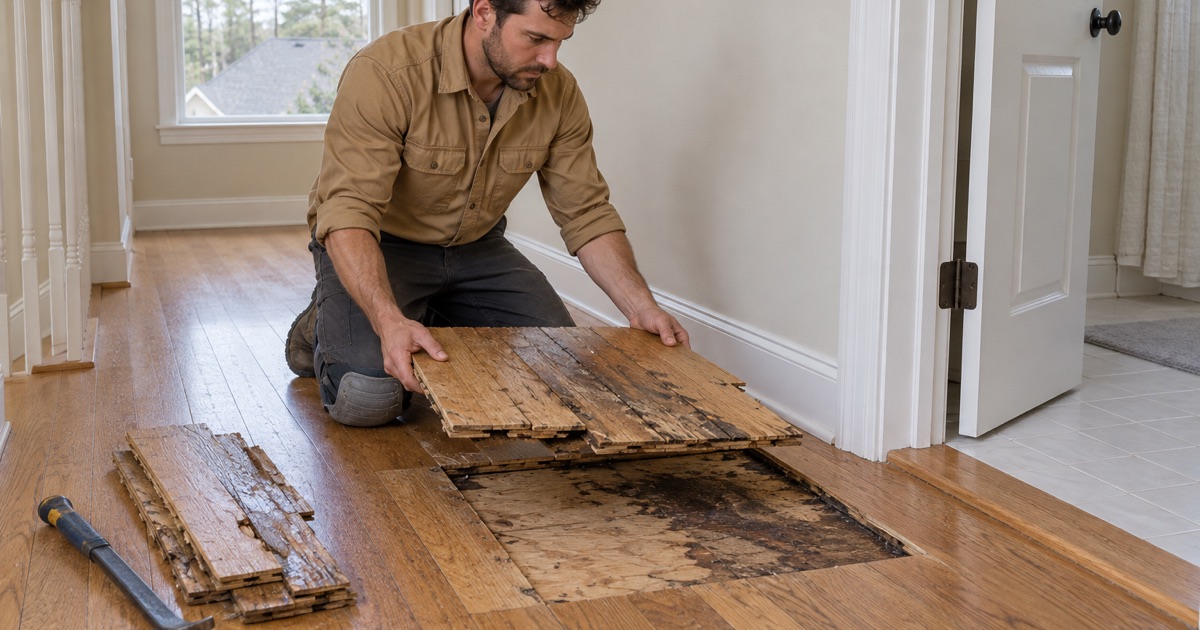
Buckling is the extreme case: boards swell so much that they lift away from the subfloor, sometimes several inches. It usually follows standing water or a long leak, and it often pulls fasteners loose. Buckled boards are rarely reusable, and the subfloor under them needs to be checked for rot and delamination before new wood goes down.
Floating floors buckle differently: the whole floor can rise where it meets a wall because the expansion gap closed as the boards swelled. Those floors sometimes recover once the swelling boards along the wall are trimmed and the room dries.
Black Stains and White Finish
Water that sits in oak reacts with its tannins and turns the wood dark gray or black, often starting at board ends and nail holes. White or cloudy patches in the finish are a different problem: moisture trapped in the finish itself, usually from a spill or a plant pot. The first normally needs board replacement; the second often only needs the finish sanded and recoated.
We test a small area before promising either result. A light sanding shows quickly whether a dark stain sits in the finish or has soaked into the wood, and that one test changes the estimate more than anything else on a water job.
Tracing, Drying and Measuring
Finding Where the Water Went
Water travels along boards, under baseboards and across the subfloor, so the visible stain rarely shows the full extent. We map the wet area with a moisture meter across the room and into neighboring rooms, checking readings against a dry reference area of the same floor. The map decides how much of the floor is actually affected.
On homes with a crawlspace we also look below. Wet insulation, a pooled vapor retarder or a dripping supply line under the floor explains cupping that shows no obvious source from above.
Drying the Floor and Subfloor
Drying a hardwood floor takes air movement, dehumidifiers and time. Sometimes we remove a few boards to let the subfloor breathe, or open the baseboards along the wet wall. In a crawlspace home, drying the space below is as important as drying the room above.
We do not put a deadline on drying. The floor is ready when its readings match the dry reference area, and sanding before then is the mistake that turns a repair into a replacement.
Readings and Photos Room by Room
We photograph every affected room with moisture readings marked, and repeat the readings as the floor dries. That record shows how wet the floor got, how far the water traveled and when it was dry enough to repair. It is also the documentation an adjuster needs to understand the claim without guessing.
The photos are dated and organized by room in the same order as our estimate. When the adjuster reads line four of the estimate, the matching pictures and readings are right beside it, which keeps questions short and the claim moving.
Repairing What the Water Left
Boards That Dry Back Flat
When a cupped floor dries back close to flat, a full sand and refinish often restores it completely. We sand through the grit sequence, address any remaining unevenness, and finish the room so the repaired area matches the rest of the floor. This is the best outcome, and it is more common than many homeowners expect.
Some minor cupping may remain even after drying, especially on wide plank boards. A careful sanding removes it once the readings are stable, and because the floor is truly dry at that point, it stays flat rather than crowning weeks later.
Board Replacement and Lacing In
Boards that stayed black, rotted or buckled get cut out and replaced. We lace new boards into the existing rows so joints stagger naturally, then sand and finish the area with the surrounding floor. Matching species and width keeps the repair from standing out once the work is done.
Where a large area is lost, we compare the cost of partial replacement against a new floor for the whole level. Sometimes insurance, the age of the floor and matching limits make full replacement the more sensible choice.
Subfloor Repairs Under the Damage
Plywood and OSB subfloors can swell, delaminate or rot after long exposure. We check the subfloor wherever boards come up, replace damaged sections, and make sure the new subfloor is flat and fastened before any hardwood goes back down.
Mold on the underside of boards or on the subfloor is a sign the area stayed wet too long. We stop and point it out rather than covering it, because new flooring over an unresolved moisture problem fails in the same spot.
Leaks That Keep Coming Back
Appliance and Plumbing Sources
Dishwasher drain lines, refrigerator water lines, washing machine hoses and toilet supply valves cause most of the interior water damage we repair. We point out the source we find, but plumbing repairs belong to a plumber. We schedule the flooring work after the leak is confirmed fixed, so the new boards do not get the same soaking.
A simple drip pan under a washing machine or a braided supply line on the refrigerator costs little next to a floor repair. We mention those prevention steps when we see an obvious risk near new wood.
Crawlspace Humidity and Condensation
Not all water damage is a leak. A humid crawlspace with a missing vapor retarder, blocked vents or a dead dehumidifier can cup a whole floor slowly through a Georgia summer. Water from below leaves a different pattern than a spill, and fixing the crawlspace is the repair that keeps the new floor flat.
Terrace Levels and Basements
Finished terrace levels and basements sit below grade and can take on water from grading, gutters or rising groundwater. We look at the history of the room before recommending a replacement floor. Engineered wood or a floating floor that can be lifted is often the wiser choice for a space that may get wet again.
Before reinstalling anything below grade, we test the slab with ASTM F2170 in-situ probes. If the concrete still holds too much moisture after a flood, we tell you and wait, because gluing a new floor to a wet slab repeats the loss.
- 20+ Years on Wood Floors
- Free Written Estimates
- Moisture Checked Before Sanding