
Marietta Wood Flooring brings more than 20 years of hands-on work to wood-flooring in Holly Springs, and the job we are called for here is usually a floor’s first serious service rather than its fifth. Most of the hardwood we sand, patch and replace in this city went down in the last two decades, which means the owners asking us over are often the first people to decide what happens to it next.
That changes the conversation. A floor that has never been sanded still has its full thickness to work with, a prefinished floor needs a different plan than a site-finished one, and a house bought from a previous owner rarely comes with a note about which finish is on the boards. We sort those questions out on the first visit, with a moisture meter in hand and a look at what is actually on the surface, before we quote anything.
Below is how that plays out in the planned neighborhoods that define so much of the city: what the governing documents do and do not reach, why houses from different builders in one development behave differently, and how we match new boards to old ones so the floor reads as one surface.
Floors in a Master-Planned Holly Springs Neighborhood
A large share of the housing here was not built lot by lot. Harmony on the Lakes, a master-planned development, was rezoned on February 18, 2003, and construction began that same year under The Macauley Companies. The city’s own ordinance records 1,523 residential units approved across the plan, with distinct neighborhoods, amenities and village areas laid out from the start.
Many Builders Working From One Plan
The plan did not come from a single construction crew. The city lists Patrick Malloy Communities, Landon, Sharp Residential Builders, Pulte, Haven and Westminster among the builders, working neighborhoods such as The Reserve, Parkside, Grandview, The Glen, The Enclave, The Meadows and Garden Row. The Reserve alone was added in July 2003 with room for up to 273 detached homes.
For floor work, that list matters more than it looks. Two houses a short walk apart inside the same development can have different species, board widths, installation methods and finishes, because different builders working in different years could make different choices. We never assume the house next door tells us what is under your rugs. We pull a register cover or a threshold, look at the tongue and groove where we can see it, and identify what you actually have.
Why the Age of the Plan Sets the Work
Construction in Harmony on the Lakes started in 2003, and the city noted in 2008 that many sections were already complete while others were still being built. That spread means the floors inside one development can range from roughly twenty years old down to much younger. The older sections tend to be where we see the first real wear: traffic lanes from the kitchen to the back door, sun fade in front of tall windows, and finish worn through at the bottom of the stairs.
Looking for wood-flooring closer to Smyrna? See Smyrna Wood-Flooring.
Covenants, Design Guidelines and the City Overlay
Harmony on the Lakes carries two layers of rules, and homeowners sometimes ask us whether either one reaches their floors. According to the city ordinance, the development is governed by a Declaration of Covenants, Conditions, and Restrictions recorded October 28, 2004, accompanied by Design Guidelines effective September 1, 2004. Those covenants are privately enforced.
The 2008 Neighborhood Preservation District
On August 4, 2008, the Mayor and City Council adopted the Harmony on the Lakes Neighborhood Preservation District as an overlay in the zoning ordinance. The ordinance also settles what happens if the two layers ever disagree: the most restrictive standard governs. The same ordinance records the development’s overall density at 2.31 units per acre.
What That Means Before We Start
Nothing in the ordinance text we have read addresses interior floors, and we do not claim that the covenants or the overlay say anything about the hardwood inside your house. What we do is ask you to pull your own declaration and any association rules before the job is scheduled. If your association has something to say about contractor parking, dumpsters, work hours or debris, it will be in those documents, and we plan the job around it rather than learning about it from a neighbor on day two.
That is the same habit we bring to townhome and condominium work: read the governing papers first. It costs a few minutes and avoids a stalled project.
First Refinish or Replacement in a 2000s-2010s Home
Holly Springs is overwhelmingly a young housing stock. Census figures put 78.9 percent of the city’s homes as built in 2000 or later, with the 2010s the single largest decade at 2,621 homes, followed by 2,282 built from 2000 to 2009. The population grew from 3,195 in 2000 to 16,213 in 2020, and the floors went down with it.
Sand, Recoat or Replace
A floor this age usually lands in one of three places. If the finish is dulled but the wood underneath is sound, a screen and recoat restores the sheen without taking any wood off. If stains, pet urine stains, deep scratches or gray traffic lanes have reached the wood, a full sand is the fix, and we set the grit sequence by the species and the condition rather than by habit. If the floor is engineered, we measure the engineered wear layer first, because a thin veneer may allow one light sanding or none at all.
Prefinished boards with beveled edges are their own case. Sanding them flat removes the bevel on every board and changes the look of the whole room, so we talk through that trade-off before a drum sander touches the floor.
Moisture Before Sanding
Holly Springs sits in the National Weather Service forecast zone named Cherokee, and like the rest of north Georgia it has humid summers. A floor that shows cupping in August is often telling us about moisture, not wear. We read the boards with a moisture meter before any sanding, because a cupped floor sanded while wet flattens now and crowns later once it dries. If the readings are high, we find the source and let the boards settle first.
Carpet and Vinyl Out, Hardwood In
Many owners here want to take out carpet, laminate or luxury vinyl plank and put down real wood, stairs included. We pull the carpet pad and tack strip, check the subfloor for flatness, allow for acclimation and leave a proper expansion gap at the walls. Stairs are priced tread by tread, with new stair treads, risers and stair nosing, because a staircase does not quote honestly by the square foot.
Build Year Still Gets Checked
Federal lead-safe rules under the EPA RRP Rule reach homes built before 1978. In a city this young, most houses are well clear of that line, but a small number of older homes do stand here, so we confirm the build year before any sanding rather than assuming.
Matching Floors Across Rooms and Additions
Because so many owners arrived recently, a lot of our Holly Springs work starts with a floor someone else chose. Census figures show 75.1 percent of homes are owner-occupied, and 27.9 percent of owner households moved in during 2020 or later. New owners often want to extend hardwood into a room that had carpet, repair a damaged section, or make two mismatched rooms look like one.
Lacing In New Boards
When a section is damaged, whether from a leak, a pet or a register moved during a remodel, we cut out the affected boards and lace in replacements, staggering the joints into the existing run so the patch does not read as a square. We match species first, whether that is red oak, white oak, hickory or maple, then width and thickness, and we stop to reconcile any mismatch before a board goes in.
Water damage gets traced, dried, measured and photographed room by room before any board comes up, so the scope of the repair rests on readings rather than guesses.
Making Stain and Sheen Agree
A new board will not match a twenty-year-old one straight out of the box. Oak ambers over time, and older finishes can carry an orange oak tone that a fresh coat of the same stain will not reproduce. We lay out stain samples on the actual floor, use water popping when a species needs help taking color evenly, and match the sheen level so the patched room and the untouched hall reflect light the same way.
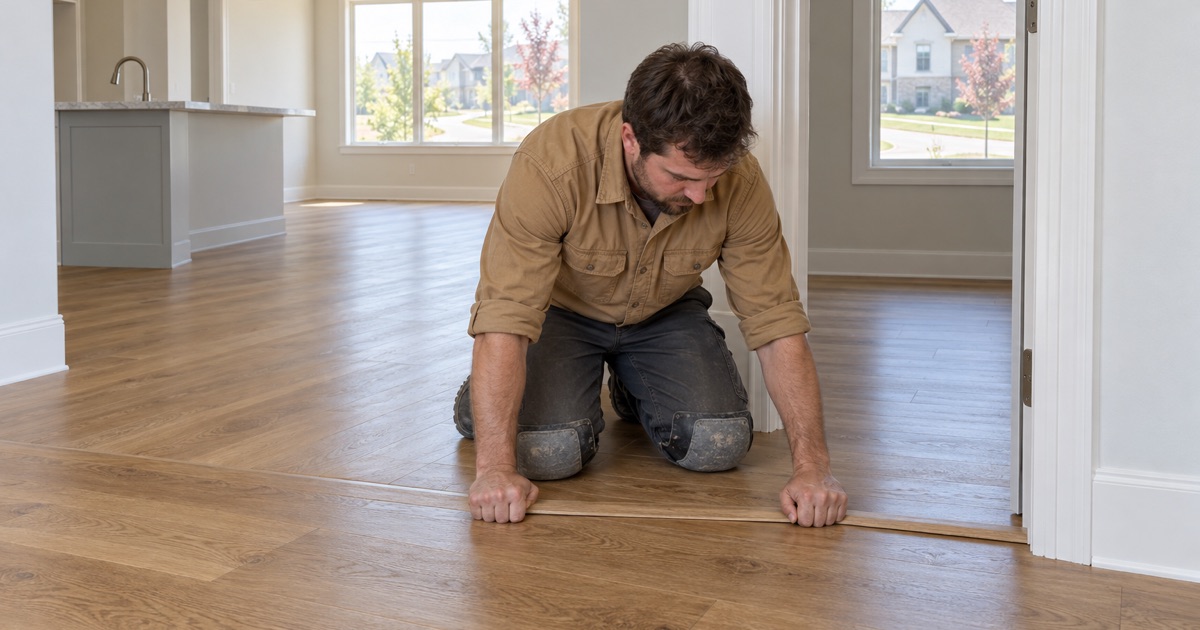
When a matched floor meets another surface, we finish the transition with a reducer or quarter round rather than leaving a raw edge.
Finish Choices and Home Sales
For the final coats we typically recommend waterborne polyurethane or oil-modified polyurethane, and we choose clear finishes by their federal VOC category under 40 CFR 59 Subpart D, not by the number meant for opaque floor coatings. Hardwax oil is an option for owners who prefer a low-sheen, spot-repairable surface.
With so many recent moves, a sale is sometimes when damage comes to light. If an Official Georgia Wood Infestation Inspection Report turns up damaged boards ahead of a closing date, we work with buyers and sellers to cut out the damage and lace in matching wood once the pest company has treated, never filling over it. We can also write an itemized estimate a landlord can put against a move-out inspection.
- 20+ Years on Wood Floors
- Free Written Estimates
- Moisture Checked Before Sanding










