
Marietta Wood Flooring brings more than 20 years of hands-on work to wood flooring in Powder Springs, from sanding and refinishing to board replacement, stair rebuilds and new installs. Most of our calls here start the same way: a homeowner pulls back a corner of carpet, finds hardwood underneath, and wants to know whether it can be saved. Our answer depends on what the boards have been through, which is why we look before we quote.
We take readings before we take anything up. A moisture meter tells us whether a cupped floor is still wet, and we let it settle before a drum sander touches it, because a crown ground flat in a humid August turns into a dip by winter. Damage from subterranean termites or powderpost beetles gets cut out and laced in with matching boards after the pest company treats, never packed with filler.
The rest of this page walks through the houses themselves. The city’s own planning documents describe distinct eras in distinct parts of town, and the floor work that fits a 1960s ranch is not the work that fits a 1990s subdivision a mile away.
Floors in the 1960s Ranch Houses Along New Macland Road
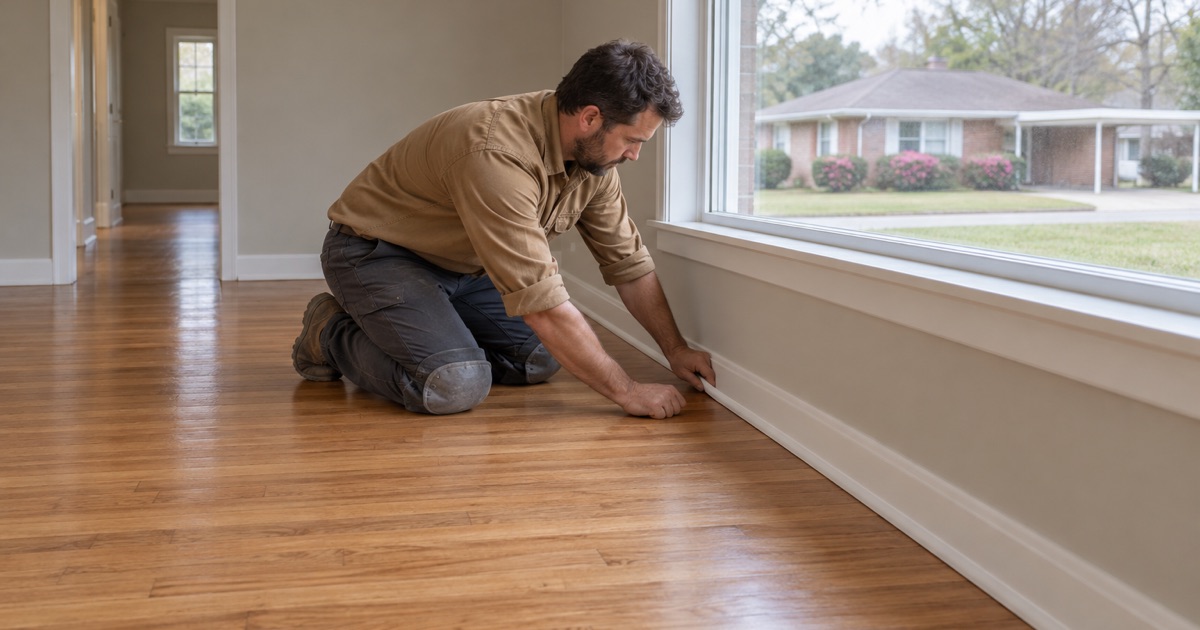
The City of Powder Springs described its North Central section in a community assessment prepared for the 2005-2025 comprehensive plan update. The housing there, it said, is predominantly 1960s era ranch-style homes on half-acre lots, clustered around New Macland Road. That is a specific kind of house with a specific kind of floor history.
Census figures back the era up across the city as a whole. Of the 6,965 housing units counted in the ACS 2024 five-year estimates, 737 were built in the 1960s. That is a small share of a city that has mostly grown since, but those units are concentrated in a few sections, and they are the ones where we find the most layered floors.
What Six Decades Leaves on a Ranch Floor
A single-story ranch puts every room on one level, so the hardwood runs continuously from the front door through the hallway and into the bedrooms. Over sixty years, that run collects traffic lanes down the hall, sun fade under the living room windows, and water stains beside the kitchen and bathroom thresholds. Pet urine stains often turn up in a bedroom corner once the carpet pad and tack strip come out.
Many of these floors were covered in carpet decades ago, which protected the surface but left thousands of staple and nail holes around the perimeter. We fill those, check for hollow spots where the subfloor has moved, and judge the wear layer before choosing a grit sequence. A floor that has already been sanded two or three times gets a lighter cut.
Patching Where Walls and Registers Came Out
Ranch houses get remodeled. A kitchen wall comes down to open the living space, a floor furnace is abandoned when central air goes in, or a register gets moved during a duct change. Each one leaves a gap or a mismatched patch in the hardwood.
We weave replacement boards into the old run rather than laying a square patch that reads as a repair from across the room. The new boards are staggered into the existing tongue and groove, sanded with the rest of the floor, and stained from samples mixed on site so the color matches the aged wood around them.
Lead-Safe Work in Pre-1978 Homes
Every house built in the 1960s falls under the EPA RRP Rule, which covers renovation work in homes built before 1978. Sanding near painted baseboards, quarter round and door casings can disturb old paint, so we confirm the build year before any sanding starts. Where the rule applies, we set up containment and cleanup to match it.
Looking for wood-flooring closer to Sandy Springs? See Wood-Flooring Services in Sandy Springs.
Older Homes in the Southeast Section
The same community assessment called the Southeast the older part of the city, with most development occurring in the 1950s and 1960s. It lies south of Marietta Street and east of the Norfolk Southern rail line. Those descriptions date from 2007, so we treat them as a guide to era rather than a current count of what stands there.
The citywide census count for the 1950s is small, just 29 units, which means houses from that decade are few and scattered. When we do find one, it tends to carry more history in its floor than anything else in town.
Old Finishes Under the Carpet
Floors from the 1950s and early 1960s were often finished with shellac or kept with paste wax, and later owners sometimes put polyurethane over the top without stripping first. The result is a finish that peels, clouds or refuses to take a new coat. We test a spot to identify what is on the floor, then strip the wax and shellac fully before a modern finish goes down.
Linoleum and black mastic are another common find in kitchens from this era. We identify the adhesive before deciding how to remove it, and we do not sand mastic, because the dust from older asphalt-based adhesives is not something to put in the air of an occupied house.
Board Damage and the Closing Calendar
Older houses change hands, and a Georgia termite letter or wood-destroying insect report can turn up damaged boards weeks before a closing. We help sellers and buyers alike in that window. We document the damage, cut out the affected boards once treatment is done, and lace in new wood that takes the same stain.
Frass, mud tubes and soft spots near exterior walls are the signs we look for first. An old house borer or powderpost beetle problem looks different from subterranean termites, and the repair plan follows what the inspector and pest company found rather than what we guess.
1990s Subdivisions in the Northwest
The assessment described the Northwest, west of Old Lost Mountain Road and north of US 278, as characterized by newer 1990s single-family subdivisions. Census figures show how large that decade was for the city: 1,742 units built in the 1990s, a quarter of the housing stock. Another 41.0 percent went up in 2000 or later.
It also noted that the Northeast has neighborhoods dating from the 1960s through the 1990s. So a single drive across the north side of Powder Springs can pass a ranch from the first era and a two-story subdivision house from the last.
Builder Oak, Refinished Rather Than Replaced
Subdivision homes from the 1990s and 2000s often have site-finished red oak in the foyer, dining room and kitchen, with carpet upstairs. Thirty years in, that oak has gone orange, worn through in front of the sink, and gapped along the seams where the house dries out each winter. None of that means the floor has to come out.
We check how much wood is left above the tongue before recommending a full sand. If there is enough, we refinish, and that is when the orange tone can shift toward a natural or gray-leaning stain. If the finish is only dulled, a screen and recoat can restore the sheen for a fraction of the work.
Carpet Upstairs, Stairs by the Tread
A frequent project in these houses is pulling the carpet from the second floor and the stairs and running hardwood through. We match the new boards to the downstairs species where the owner wants a continuous look, or add a reducer where the two floors meet at a different height.
Stairs are quoted tread by tread, not by the square foot. Each staircase gets new stair treads, stair risers and stair nosing as needed, and the landing is built to tie into the upstairs floor. Carpet, laminate and luxury vinyl plank on the stairs all come out the same way.
Terrace Levels in Sloped Lots
Some subdivision houses sit on a slope with a finished terrace level below the main floor. That space is below grade, and solid hardwood does not belong there. We install engineered wood instead, either glue-down or as a floating floor over a vapor retarder, with the engineered wear layer chosen for how the room is used.
A Historic Town Center With Suburbs Around It
The assessment summed up the city’s layout plainly: a historic town center, with newer suburban corridor commercial uses and large tract subdivisions radiating from the historic core. Low density residential land made up 51.9 percent of the city’s acreage in spring 2005, and 85.1 percent of units today are one-unit detached homes.
That pattern is the reason our work here varies so much by address. The houses nearest the center carry the oldest floors, and the subdivisions farther out carry the newest, with the ranch sections sitting between them in both time and distance.
The Town’s Older Core
Powder Springs was incorporated as Springville in 1838 and renamed in 1859, taking its name from the seven springs inside the city limits. The Seaboard Coastline Railroad later connected the town to Atlanta and Birmingham, and the assessment traces how it shifted from a farming enclave into a bedroom community.
Downtown now holds the Seven Springs Museum and the Butner-McTyre General Store at 4455 Marietta Street, which is listed on the National Register of Historic Places. Homes near that core are the ones where we slow down most, because the floor may have been refinished, patched and covered several times before it reaches us.
Finishes, Dust and Living in the House
Most families stay in the home while we work. We run dustless sanding with an orbital sander on the edges, and we choose clear finishes by their federal VOC category under 40 CFR 59 Subpart D rather than a number meant for opaque floor coatings. Waterborne polyurethane dries fastest for an occupied house, while oil-modified polyurethane and hardwax oil each suit a different look and upkeep routine.
For water damage, we trace the source, dry the area, and measure and photograph each room before any board is pulled. Landlords in the rental share of the city get an itemized estimate that can stand against a move-out inspection, and townhome owners get their association declaration checked before work begins.
- 20+ Years on Wood Floors
- Free Written Estimates
- Moisture Checked Before Sanding










