
Marietta Wood Flooring has handled wood-flooring in Smyrna for more than 20 years, and much of that work comes down to plain upkeep: floors that have worn thin, boards stained by a leak, and rooms a landlord needs ready before the next lease starts. We repair, refinish and replace hardwood for homeowners and rental owners who want the floors in good order before anyone else starts asking about them.
A floor rarely fails all at once. Traffic lanes wear through the finish in a hallway, a pet stain darkens the boards by a back door, a dishwasher line seeps under the kitchen run until the edges cup. Each one is easy to put off, and each one gets more expensive the longer it waits.
Our approach is to look at the whole floor before quoting any part of it. We meter damp boards, check how much wood is left above the tongue, and write the estimate in line items so an owner can see exactly what the repair covers and what it leaves alone.
How Smyrna Enforces Property Maintenance
Smyrna has a Code Enforcement Division, and its city marshals enforce two sets of property maintenance rules: the City Code of Ordinances and an adopted edition of the International Property Maintenance Code, which the city also calls the Smyrna Property Maintenance Code. The city’s own page says the Council adopted the 2006 edition in 2010 as a supplement to the City Code.
Another source points to the 2018 edition under Sec. 80-39 of the municipal code, and we have not seen the two reconciled. Separately, Georgia’s State Minimum Standard Property Maintenance Code is the 2018 IPMC read together with the state’s own amendments, which the Department of Community Affairs revised on January 1, 2021. If the edition matters to your situation, the marshals are the ones to ask.
From Warning Letter to Citation
The process starts gently. When a marshal finds a violation, the city first sends a warning letter to the owner or the renter. If the problem is still there after that, it becomes a formal citation, and a citation comes with a required court appearance.
We are careful about what we claim here. The property maintenance code is the city’s to interpret, so we will not quote it to you, and no flooring contractor can promise how a marshal will rule. What we can do is fix the damage itself, document it, and hand you paperwork showing what was done and when. Code Enforcement answers questions at 678-631-5387.
Why Upkeep Beats a Deadline
Work done on your own schedule costs less than work squeezed between a letter and a court date. A board replacement planned for a quiet week can wait for matching stock and a proper drying period. The same repair rushed to meet a deadline tends to cut corners nobody wants to pay for twice.
It also leaves a paper trail. Dated photographs, moisture readings and an itemized invoice show that a problem was noticed and handled, which is the kind of record an owner wants on file whether or not anyone ever asks for it.
Looking for wood-flooring closer to Kennesaw? See Wood-Flooring in Kennesaw.
Floor Repairs Owners and Landlords Put Off
Most of the floors we are called to in Smyrna were not neglected on purpose. They slipped down the list behind a roof, a water heater or a vacant unit that needed filling, and the damage kept spreading while nobody looked at it.
Water Stains and Cupped Boards
Water is the repair that gets worse fastest. We trace where it came from, dry the area, and measure and photograph each room before a single board comes up, so the scope is on record. A cupped floor is read with a moisture meter first, because sanding a floor that is still wet leaves it crowned once the boards dry back.
Buckling, hollow spots underfoot and dark water stains around a sink or toilet usually mean the subfloor needs a look as well. We open only as much as the damage requires and lace new boards into the old run so the patch does not read as a patch.
Insect Damage Found at Inspection
Subterranean termites and powderpost beetles leave boards that look sound from above and crumble under a screwdriver. Mud tubes along a joist or fine frass on the floor are the usual clues. Once the pest company has treated, we cut out the damaged wood and lace in matching boards rather than filling over the holes.
The same damage often surfaces when a house is under contract. If the Official Georgia Wood Infestation Inspection Report turns up bad boards ahead of a closing date, we can give the seller or the buyer a written scope and schedule the repair around the timeline. We work from that same report, so the repair scope lines up with the boards the inspector flagged.
Gaps Left by Old Fixtures
A wall taken out, a floor furnace removed or a register moved leaves a hole or a strip of mismatched wood. We weave boards into the existing run so the repair follows the grain of the room instead of sitting in it like a lid. The same technique closes the line where two rooms were joined, and it lets us add a reducer or quarter round only where a transition truly needs one.
Refinishing Worn Floors in Older Smyrna Homes
Smyrna’s housing stock runs from 234 units built before 1940 to 645 finished since 2020, and a real share of it has some age on it. Of the city’s 27,040 housing units in the Census Bureau’s 2024 five-year estimates, 27.5 percent were built before 1980, including 2,258 from the 1950s and 2,075 from the 1960s. The largest single decade is the 1980s, with 6,225 units.
Checking What Is Left to Sand
An older floor may already have been sanded more than once. Before a drum sander touches it, we pull a vent cover or a threshold and check how much wood sits above the tongue. If there is enough, we refinish; if the boards are nearly down to the tongue, we say so and price replacement instead.
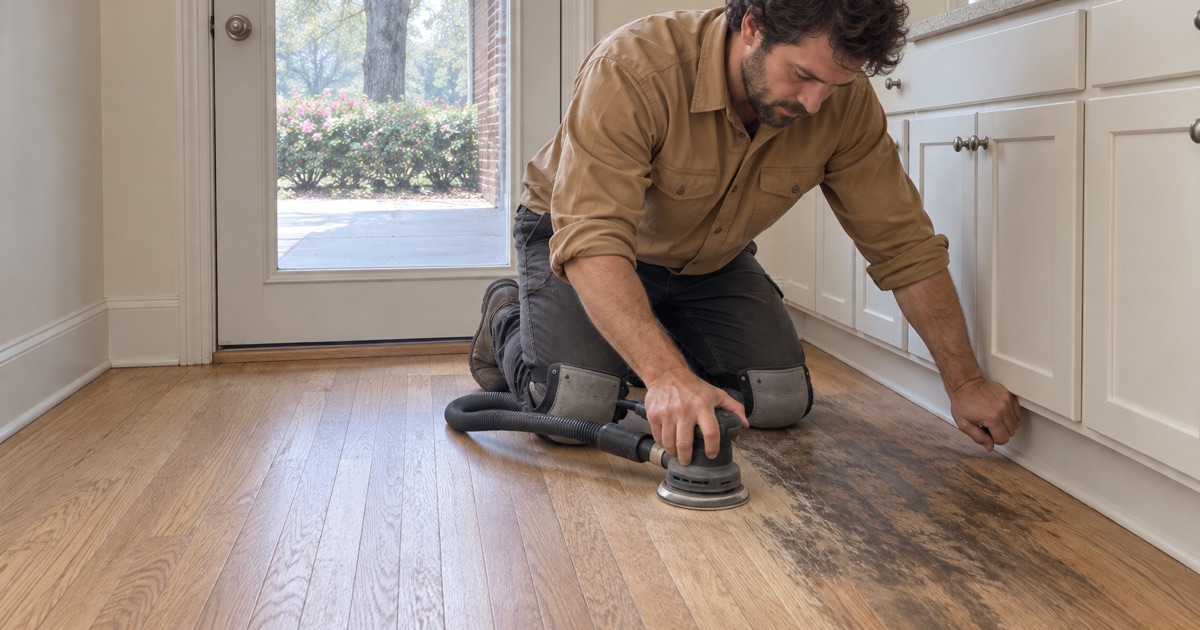
Builder-grade red oak and white oak from Cobb County subdivisions often has room for another full sanding. Those floors tend to show traffic lanes, sun fade near windows and an orange cast in the old finish, and a proper grit sequence takes them back to bare wood without tearing anything out. Dust control matters in an occupied home. We run dustless sanding equipment connected to a vacuum and seal off the rooms we are not working in.
Old Finishes and Build Year
Floors from the 1950s and 1960s sometimes carry paste wax or shellac under later coats. We identify it and strip it first, because a modern polyurethane laid over wax will not bond properly.
We also confirm the build year before any sanding. Federal lead-safe work rules under the EPA RRP Rule reach homes built before 1978, and in a rental that matters to the tenant as much as to the owner. For finishes, we pick clear coats by their federal VOC category under 40 CFR 59 Subpart D, and we will walk you through waterborne polyurethane, oil-modified polyurethane or hardwax oil for your household.
Stain Samples and Sheen
On a full refinish we lay stain samples on the bare floor in your own light, and we water-pop the boards first when a darker color needs to take evenly. Sheen level is a separate choice. Satin hides the scuffs of daily life better than gloss, which is worth weighing in a rental that will see heavy use.
Keeping Rental Units in Good Repair Between Tenants
Renters make up a large part of the city. Of Smyrna’s 24,809 occupied homes, 10,084 are renter-occupied, or 40.6 percent, and 2,084 of those renter households live in buildings of ten to nineteen units. Because a warning letter can go to the renter as well as the owner, a worn or damaged floor in a rental can become a concern for both sides of the lease.
The Turnover Window
The easiest time to fix a rental floor is the gap between one lease and the next. Depending on wear, that might mean a screen and recoat to refresh the finish, a full sand where pet urine stains or deep scratches have gone through, or board replacement in the spots that took the worst of it. We tell you plainly which option the floor needs, and if a lighter pass will hold for another lease, we say so.
Estimates a Landlord Can Use
When a tenant moves out and leaves damage behind, an itemized estimate helps. Ours separates normal wear from specific damage, room by room and line by line, so a landlord has something concrete to set against the move-out inspection.
Attached housing is common here, with 4,724 single-family attached units in the city’s count, and an attached home may answer to an association. Before we start, we check the rules in your own declaration for work hours, noise and materials, so fixing a floor does not trade one notice for another.
Replacing Worn-Out Flooring
Some units reach the point where the carpet, laminate or luxury vinyl plank is the problem. We pull it, along with the carpet pad and tack strip, and put down hardwood, stairs included, with each staircase priced tread by tread rather than by the square foot. For a terrace level or anything below grade, we use engineered wood, since solid hardwood does not belong there.
When the Unit Is Still Occupied
Occupied units need a different plan. We sequence the rooms so a tenant keeps a usable path through the home, give a realistic cure time before furniture goes back, and tell you in advance which days the unit needs to be clear.
If a letter from the marshals has already arrived, call us with the date on it. We will look at the floor, tell you what the repair involves and how long it takes, and give you a written estimate you can keep with the rest of your records.
- 20+ Years on Wood Floors
- Free Written Estimates
- Moisture Checked Before Sanding










