
Marietta Wood Flooring brings more than 20 years of wood-flooring in Vinings work to a job that often starts with a wet floor rather than a worn one. When water has sat on hardwood, the useful question is not how the floor looks this week but what the boards, the subfloor and the room will do over the next month. We answer that with readings, photographs and a written plan before anyone pulls a board.
Some of the calls we take here are straightforward refinishing, stair work or carpet coming up for hardwood. Many are not. A floor that took on water, or one that has lived with damp for a long time, needs to be traced, dried and measured room by room, because the damage rarely stops at the stain you can see.
This page covers how we handle that work: what water does to wood, how we decide what can be saved, and what goes back down when a floor has to be replaced. The same approach applies whether the water came from the river, a failed supply line or years of slow damp.
When the Chattahoochee Came Up in 2024
Vinings is an unincorporated community in Cobb County that sits along the Chattahoochee River bank, across from Buckhead. That location shapes a lot of the flooring work we do here, and Hurricane Helene in September 2024 made the reason plain.
What the Weather Service Recorded
According to the National Weather Service office in Atlanta, three sites along the Chattahoochee in Cobb County, at US 41, at Paces Ferry Road and at Highway 280, rose to Major Flood Stage during Helene. Two of those sites reached levels second only to September 2009. The same report describes catastrophic impacts to the areas along the river.
In Vinings itself, a firefighter and inspector reported submerged vehicles and a swift-water rescue at Brandy Station SE and Woodland Brook Dr SE. The Weather Service also listed widespread inundation of roads and structures along Paces Ferry Road, Cochise Drive, Paces Ferry Drive, Paces Manor and Farmington Drive. Radar estimates put 8 to 10 inches of rain over the county, and eleven Cobb river gauges reported flooding.
The Flood Helene Was Measured Against
The benchmark in that report is September 2009. A USGS fact sheet on that flood states that the gage on the Chattahoochee at Vinings reached the highest level recorded in the past 81 years. So when two Helene readings came in second only to 2009, they came in second to the highest water this stretch of river had seen in generations.
None of this means a given Vinings street floods, and we do not treat it that way. The Weather Service named specific streets, and most homes here were never touched. What it does mean is that when a homeowner near the river calls about a stained, cupped or soft floor, we ask about water first and cosmetics second.
Looking for wood-flooring closer to Mableton? See Mableton Wood-Flooring.
What River Water Does to a Wood Floor
Hardwood is a material that takes on and gives up moisture, and floodwater pushes it well past anything a normal Georgia summer does. The result shows up in stages, and some of it does not appear until weeks after the water is gone.
Cupping, Crowning and Buckling
The first sign is usually cupping, where the edges of each board rise above the center because the underside is wetter than the top. If the water was heavy enough, the boards run out of room and the floor buckles, lifting off the subfloor in a ridge. Solid hardwood in tongue and groove has very little slack once the expansion gap at the walls is used up.
The mistake we see most often is sanding a cupped floor too soon. If the boards are still wet, sanding the edges flat leaves them crowned once they dry, with the center now higher than the edges and the wear layer thinner than it should be. We read moisture with a meter before a cupped floor is sanded, and we wait for the numbers rather than the calendar.
Stains, Hollow Spots and the Subfloor
River water is not clean water. It carries silt and whatever it picked up on the way, and it leaves dark water stains that often run into the grain along the board seams. Where it soaked the subfloor, the boards above can pull loose from their flooring cleats or staples and sound like hollow spots when you walk across them.
Below the finished floor, a subfloor that stays wet can delaminate or lose its hold on the fasteners. We check it at several points, not just where the stain is, because water travels under a floor along the joists and seams in ways the surface does not show.
Long-Standing Damp Is Its Own Problem
Plenty of wet floors here never saw a storm. A floor near a leaking door, a low grade or a lower level that never quite dries can show the same cupping and gapping slowly, over seasons. That kind of damp is harder to spot and just as damaging to the finish and the fasteners.
It is also the condition wood-destroying insects prefer. When we find soft or crumbling boards in a damp area, we look for frass and mud tubes before assuming the damage is water alone. If a pest company needs to treat first, we wait, then cut out the damaged boards and lace in matching ones rather than filling over them.
Drying, Testing and Deciding What Stays
Once the water is gone, the most useful thing a homeowner can do is resist the urge to rip everything out or to refinish right away. Both can be the right call, but only after the floor has been measured.
Tracing and Documenting Room by Room
We start by tracing where the water went. That means moisture readings across each room, into the next room and along the walls, so we know the edge of the wet area rather than guessing at it. Every reading and every damaged section gets photographed and written down.
That record matters for more than our own planning. It gives you a room-by-room account of what was wet, how wet it was and when, which is useful to anyone else who needs to see what happened to the floor. We keep it factual and leave the conclusions about coverage to the people who make them.
Drying Before Deciding
Drying takes time, and the pace depends on how long the water sat, what is under the floor and how the house is being dehumidified. We take readings on repeat visits and compare them, because a single reading tells you where the floor is today and not whether it is still improving.
Some floors that looked ruined in the first week settle back close to flat once the moisture evens out. Others stay cupped or keep moving, and that tells us the damage is structural rather than temporary. The decision about what to save is easier and cheaper once the drying curve is visible.
What Can Usually Be Saved
A solid hardwood floor that dried back close to flat, with enough wood left above the tongue, is often a good candidate for sanding and refinishing. Isolated sections with deep water stains or loose boards can usually be cut out and laced in with matching stock, woven into the old run so the repair does not read as a patch.
Engineered wood is less forgiving. A thin engineered wear layer that has swelled or separated from its core generally cannot be sanded back, and glue-down or floating engineered floors that took on water are usually replacement jobs. Laminate and luxury vinyl plank over a wet subfloor are a separate issue, since the product may look fine while the layer beneath it stays damp.
Replacing a Floor and Planning the Next One
When a floor cannot be saved, the tear-out is the easy part. The work that decides how the new floor performs is what happens between the old one coming up and the new one going down.
Tear-Out and Subfloor Checks
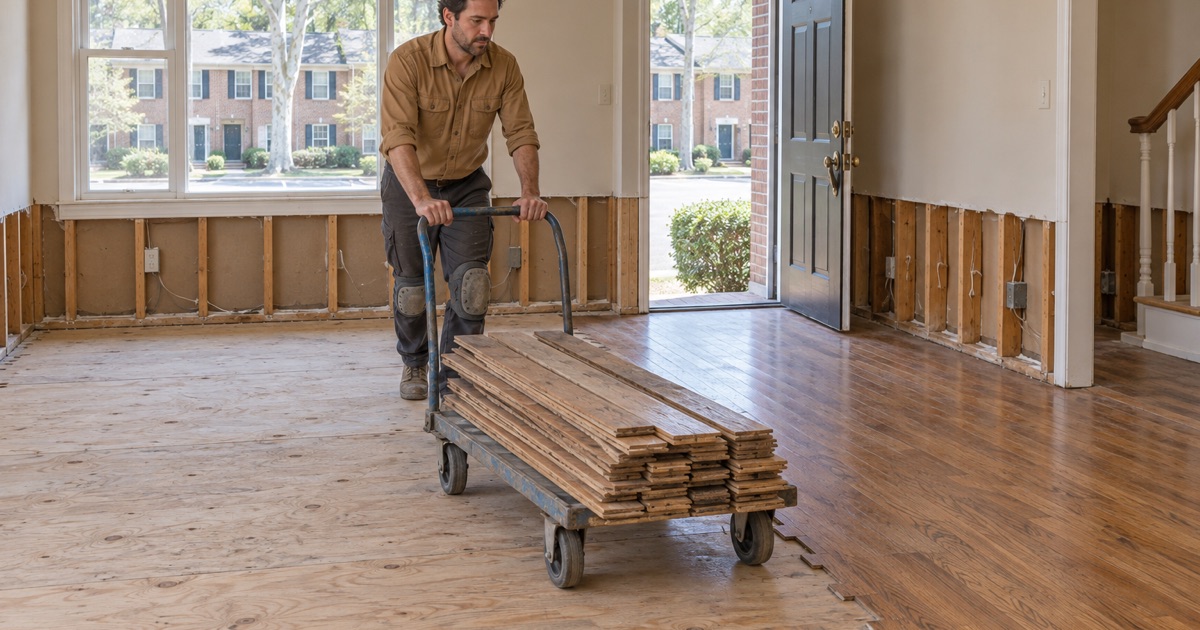
We remove the damaged flooring, carpet pad and tack strip where needed, and then read the subfloor and framing directly. Any section that stayed wet, delaminated or lost its fastener hold gets addressed before new wood goes near it. Installing over a subfloor that is still drying simply moves the cupping problem into the new floor.
Build year matters here too. Around 43.9 percent of Vinings housing units were built in 2000 or later, but 20.8 percent predate 1980. Federal lead-safe rules reach homes built before 1978, so we check the build year before sanding or disturbing older painted surfaces around the floor.
Choosing Materials for a Riverside Home
Solid hardwood still makes sense on main floors that stayed dry, and we install it with proper acclimation and a full expansion gap. For terrace levels and any space below grade, we recommend engineered wood, because solid boards do not belong there and a lower level near the river is exactly where moisture returns.
For finishes, we walk through waterborne polyurethane, oil-modified polyurethane and hardwax oil with you, and we choose clear finishes by their federal VOC category. If you are matching an existing floor in the rest of the house, we run stain samples on the actual boards so the new section blends with the old.
Living With the River
Vinings sits in the NWS Cobb forecast zone, and FEMA’s Flood Insurance Study for Cobb County carries a flood profile for Vinings Branch, from its confluence with the Chattahoochee to just below Randall Farm Road. We do not say whether any particular property is in a mapped flood zone. That is a question for the county and the flood maps, not a flooring contractor.
What we can do is build the next floor with the river in mind. That means a vapor retarder where the assembly calls for one, engineered wood where it belongs, a dehumidifier plan for lower levels, and a meter reading before any floor is sanded or installed. A floor put down that way stands a better chance of coming through the next high water with only a drying-out rather than a rebuild.
- 20+ Years on Wood Floors
- Free Written Estimates
- Moisture Checked Before Sanding










