
Marietta Wood Flooring handles wood-flooring in Woodstock for households who want their hardwood to hold up to the way they actually live, and we bring more than 20 years of sanding, repair and installation to each job. Most of the calls we get here are about wear at the edges of a house: the front door, the back slider, the hallway a dog runs down twenty times a day. Those are the places where finish thins first and where a small fix now saves a full refinish later.
We start every visit by looking at the floor before we talk about products. A worn traffic lane, a gray patch by the door and a board that sounds hollow underfoot each call for a different answer, and the right one is often smaller than a homeowner expects. When a floor does need more, we explain the sequence, the drying time and the cost before any equipment comes off the truck.
The sections below walk through what we see most often in this part of Cherokee County and how we approach it: grit tracked in from outdoors, damp shoes and paws, and the moisture questions that come with living near water. If you already know what your floor needs, a short visit and a written estimate is the next step.
Woodstock’s Creeks and the Greenprints Trails
A Trail Plan Built Around Water
Woodstock adopted its Greenprints master plan in June 2008 as part of the Comprehensive Town Plan 2030, and the plan calls for more than sixty miles of trail and open space across the city. What stands out when you look at the named trails is how closely they follow water. Noonday Creek Trail connects Downtown Woodstock to Highway 92 and crosses the creek on a bridge, Rubes Creek Trail runs along Rubes Creek, and Trestle Rock Trail sits alongside the Little River.
Towne Lake Pass follows the Noonday Creek corridor under I-575, and the city’s Connect the Creeks effort has looked for routes linking the Noonday Creek and Rubes Creek trails. For a lot of households, that puts a walk, a run or a bike ride a few minutes from the front door. It also means the floor just inside that door sees the results.
Why a Flooring Company Pays Attention to Trails
We are not suggesting a trail is bad for a floor. Trails are simply one of the ordinary sources of wear we plan around, alongside kids, pets, furniture and sunlight. A household that comes home from a creek trail several times a week brings in fine sand, clay dust and sometimes wet soles, and the entry floor is where that shows up first.
Knowing how a household uses the house helps us choose the finish, the sheen level and the maintenance plan. A family that runs the dog on a trail every morning needs a different recommendation than a couple who mostly come and go through the garage. We ask those questions at the estimate because they change the answer.
A City That Describes Itself by Its Water
The city’s own stormwater page says Noonday Creek, the Little River and numerous other creeks and wetlands flow all around and through Woodstock, and that the city is surrounded by water. It points back to the catastrophic flood of September 2009 as the reminder. We keep that in mind when we plan work here, and we return to it in the moisture section below.
Looking for wood-flooring closer to Acworth? See Wood-Flooring in Acworth.
Trail Grit, Wet Shoes and Pet Paths
How Grit Wears Through Finish
Sand and fine grit behave like loose sandpaper under a shoe. Each step grinds away a little of the top coat, and after a season or two the path from the door to the kitchen turns dull while the rest of the room still shines. Those traffic lanes are finish wear first, and if they are caught early, the wood underneath is untouched.
Once the finish is gone, bare wood starts to take on dirt and moisture and turns gray. At that point a screen and recoat is no longer enough, and the fix becomes sanding down to fresh wood. The difference in cost between those two jobs is the strongest argument we know for good mats and an early recoat.
Wet Shoes, Paws and Water Stains
Water sitting on a hardwood floor finds the seams between boards. A wet pair of shoes left by the door overnight can leave a white ring in the finish, and repeated wetting in one spot can lead to dark water stains that reach the wood itself. White marks usually live in the finish and can often be handled with a recoat, while black ones generally mean board replacement.
Pets add their own pattern. Dogs coming in from a walk carry water and grit on their paws, and their nails scratch the finish along the same few paths every day. Pet urine stains are a separate problem, because urine soaks into the wood and often needs the affected boards cut out and new ones laced in.
Planning the Entry and Mudroom Floor
Entryways and mudrooms get the hardest use in the house, so we treat them as their own zone. For those areas we often suggest a harder species or a tougher finish, along with a lower sheen level that hides scratches and dust better than gloss. Janka hardness is a useful guide here, and hickory and white oak resist dents better than softer woods.
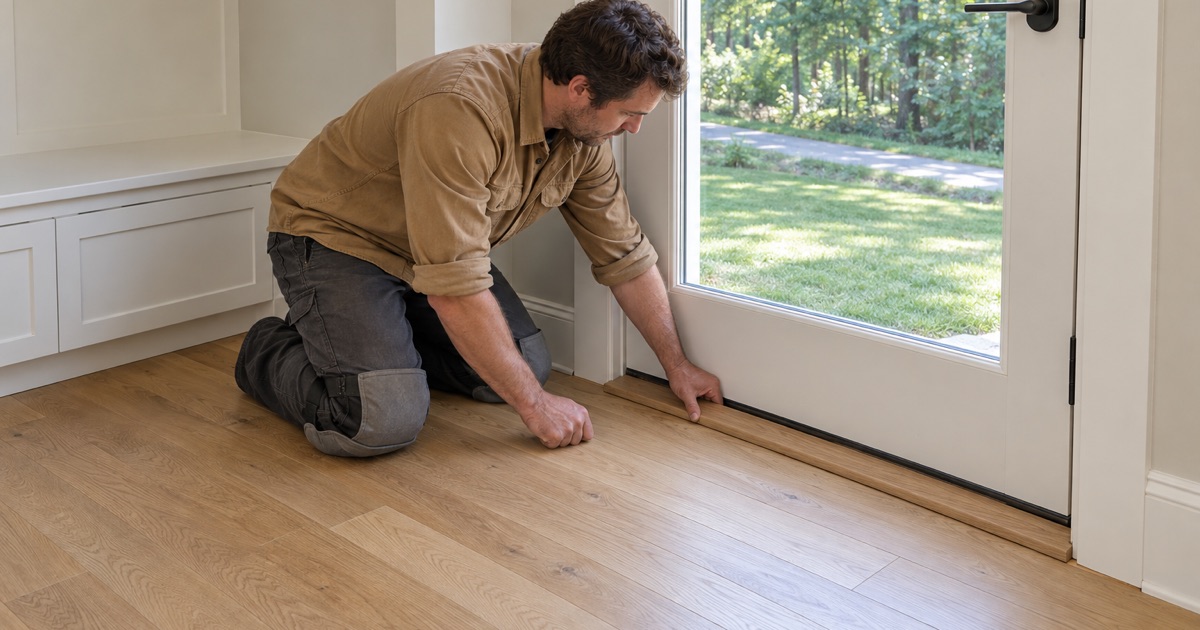
Where a homeowner wants to replace carpet, laminate or luxury vinyl plank in an entry with hardwood, we plan the transition carefully, including the reducer or threshold at the door and any stairs that rise from the landing. Stairs are priced tread by tread rather than by the square foot, so you see exactly what each step costs.
Homes Near Noonday Creek and the Little River
The 2009 Flood as a Local Reference Point
A U.S. Geological Survey fact sheet published in October 2010 shows that during the September 2009 flood, Noonday Creek at Shallowford Road near Woodstock exceeded the level with a 0.2 percent chance of occurring in any year, commonly called the 500-year flood. That is a record for one gauge on one creek, not a statement about any particular street or subdivision. It is still a useful reminder that water moves through this city in ways a dry summer can hide.
For flooring, the practical lesson is that moisture is worth measuring rather than assuming. We carry a moisture meter to every job, and we use it before we recommend anything.
Measuring Before We Sand or Install
A cupped floor, where the board edges sit higher than the centers, usually means the wood took on moisture from below or from humid air. If that floor is sanded flat while it is still wet, the boards dry out later and the centers end up lower than the edges, a condition called crowning. We read the moisture first and wait for the floor to settle before sanding, so the fix lasts.
The same discipline applies to new floors. Solid hardwood needs time to acclimate to the house, an expansion gap at the walls and a proper vapor retarder where the subfloor calls for one. For basements and terrace levels we recommend engineered wood, because solid boards do not belong below grade.
When Water Does Get In
If a leak, a backed-up drain or storm water reaches a floor, we trace where it came from, dry the area, measure moisture and photograph each room before any board comes up. That record supports insurance conversations and shows exactly which boards need replacement. Buckling, where boards lift off the subfloor, and persistent hollow spots are both signs that we need to look deeper before planning repairs.
Keeping Finish and Boards Ahead of Wear
Screen and Recoat Before You Need to Sand
The simplest way to protect a floor that sees trail and pet traffic is to recoat it before the finish wears through. A screen and recoat lightly abrades the existing finish and adds a fresh coat without cutting into the wood. Done every few years in busy rooms, it can put off a full refinish for a long time.
We check the existing finish first, because a new coat will not bond to paste wax or some older finishes. If we find wax or shellac, we strip it before anything new goes down.
Choosing the Finish and the Sander
For high-traffic floors we usually compare waterborne polyurethane, oil-modified polyurethane and hardwax oil with the homeowner. Waterborne dries clear and fast, oil-modified adds amber warmth, and hardwax oil is easy to spot-repair. We pick clear finishes by their federal VOC category under 40 CFR 59 Subpart D, not by the number meant for opaque floor coatings.
When a floor does need sanding, we use a drum sander for the field and an orbital sander for edges and final passes, stepping through a grit sequence that leaves the wood smooth and ready for stain samples. Dustless sanding keeps most of the fine dust out of the rest of the house, which matters in open floor plans.
Build Year, Association Rules and Records
Most of Woodstock’s housing is recent, with 73.1 percent of units built in 2000 or later. We still check the build year before any sanding, because the federal lead-safe requirements of the EPA RRP Rule reach homes built before 1978. For townhomes and condominiums, we read the rules in your own association declaration before we start, since some limit work hours or flooring types.
Rentals and sales bring their own paperwork. We write itemized floor-damage estimates a landlord can set against a move-out inspection, and we help buyers and sellers when a termite inspection turns up damaged boards ahead of closing. Once the pest company has treated, we cut out the damaged wood and lace in matching boards rather than filling over it.
- 20+ Years on Wood Floors
- Free Written Estimates
- Moisture Checked Before Sanding










